Skip to the chapters

THE MIND · THE REST OF THE REPORT · DENSMORE × PROTO

Everything else
she wrote down.

The field list on the home page is one table out of a 193-page scan. This room holds the rest: how the sugar bush was measured, how a woman claimed her part of the rice field, what was said to a plant before it was dug, how birch bark was bitten into patterns by firelight. 22 chapters, 36 plates, 20 ideas to learn. Below that, the shelf: her four other Chippewa books, 1910 to 1929, with 62 highlights. Every line links to its page in a public scan, so you can check the record yourself.

22 CHAPTERS 36 PLATES 137 PAGE-CITED LINES 5 BOOKS ON THE SHELF
01

HOW TO READ THIS ROOM

Three rules, so the record stays the record.

  1. THE SCAN IS TRUTHEvery page number here is the scan's own: the number the Internet Archive viewer shows in its bar, 0 to 193, counting from the cover. Tap it and the Smithsonian scan opens on that page, on desktop and on phones. The report also carries the Bureau's printed pagination, 275 to 397 of the 44th Annual Report; we ignore it on purpose so the number you tap is the number you land on. If this page and the scan disagree, the scan wins.
  2. QUOTES ARE VERBATIMLines in quotation marks are Densmore's words or her informants' words as she printed them, lightly corrected for scanner errors only. Summaries are ours and say so by not being in quotes.
  3. RECORDS, NOT ADVICEThese are historical uses recorded between 1907 and 1928. They are not medical advice. Proto scores the record against your labs. It does not prescribe from it.
02

THE CHAPTERS

In the order the report prints them. The two sideways tables link to the scan only.

  1. 01Foreword18
  2. 02Informants19
  3. 03Phonetics21
  4. 04Introduction24
  5. 05Plants arranged by botanical, common and native name25
  6. 06Medicinal properties recognized by white medicine38
  7. 07Principal active medicinal constituents42
  8. 08Plants as food45
  9. 09Making maple sugar47
  10. 10Gathering wild rice56
  11. 11Beverages, seasonings and cereals70
  12. 12Vegetables and berries72
  13. 13Plants as medicine: treatment75
  14. 14Gathering and preparing remedies80
  15. 15Administration, appliances and surgery85
  16. 16Medicinal plants, the tabulated list91
  17. 17Dyes126
  18. 18Charms132
  19. 19Useful and decorative arts134
  20. 20The sacred trees and the Winabojo legends144
  21. 21Gathering bark and the articles made from it149
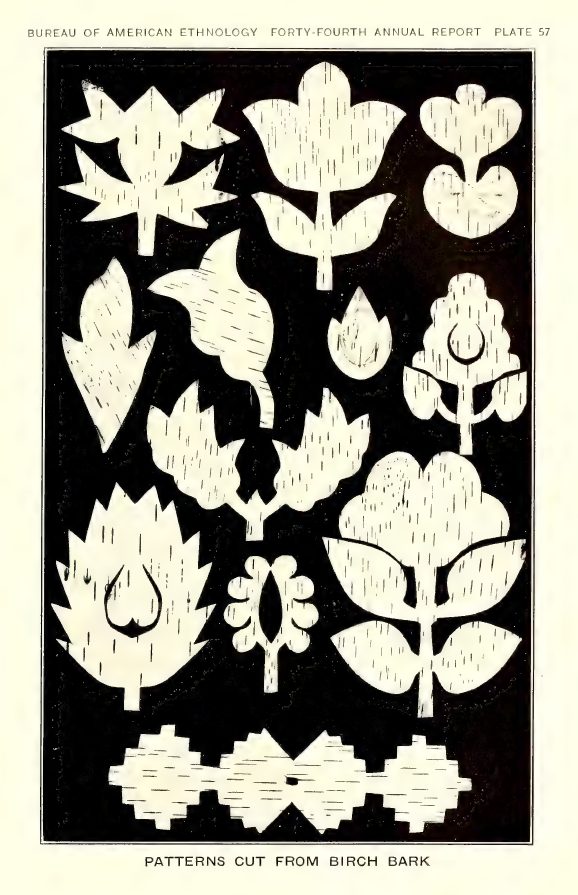
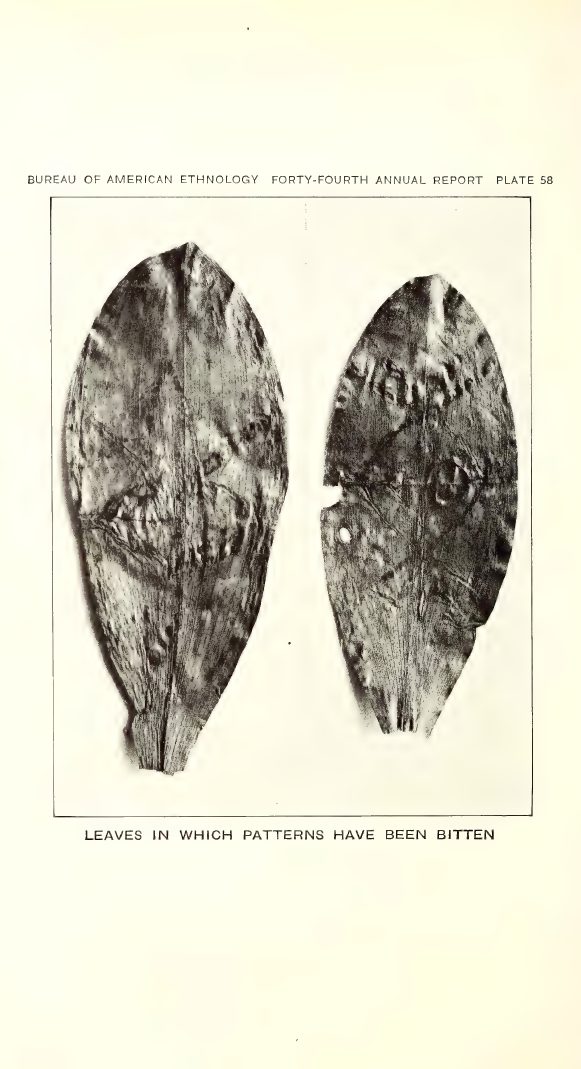
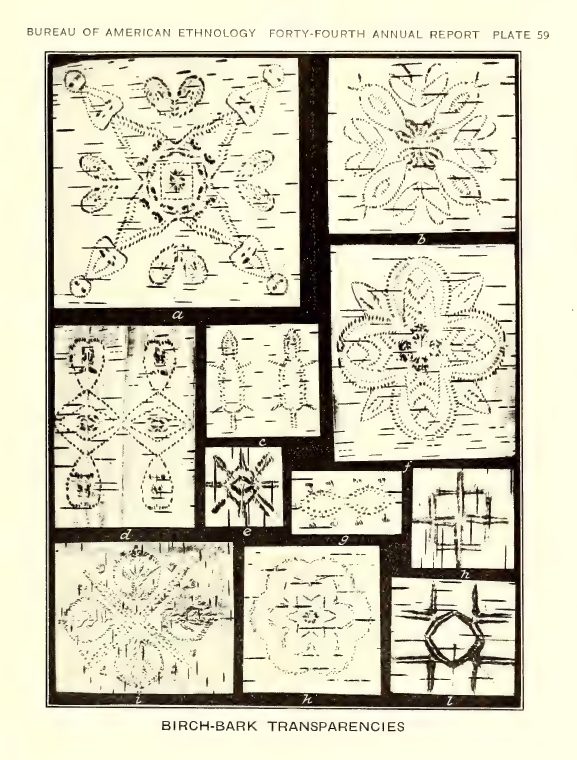
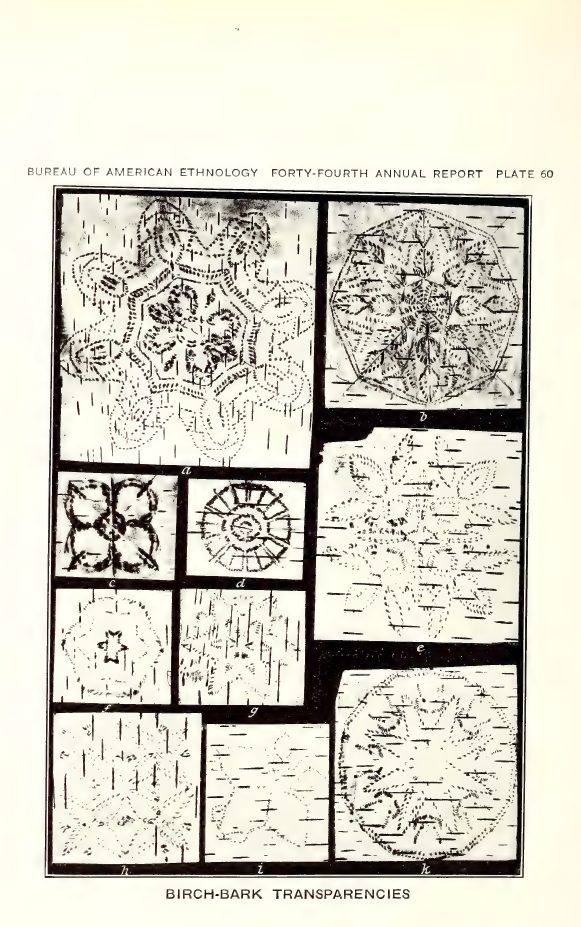
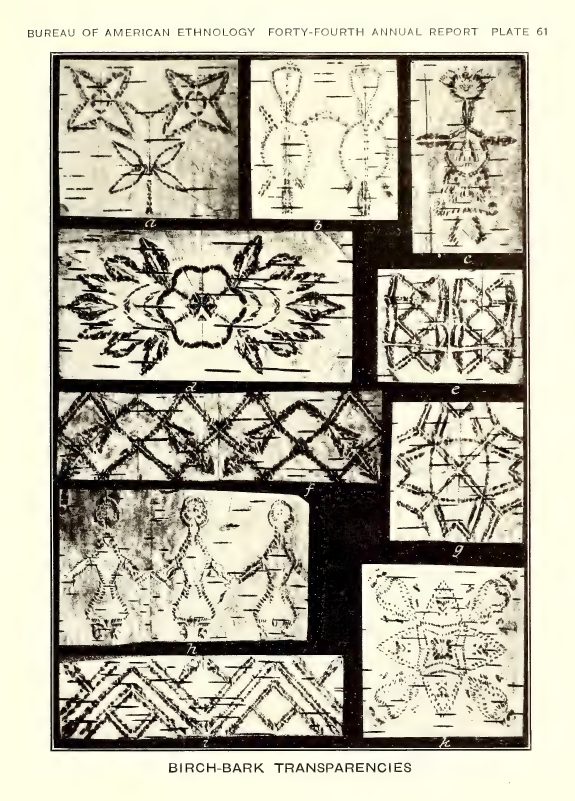
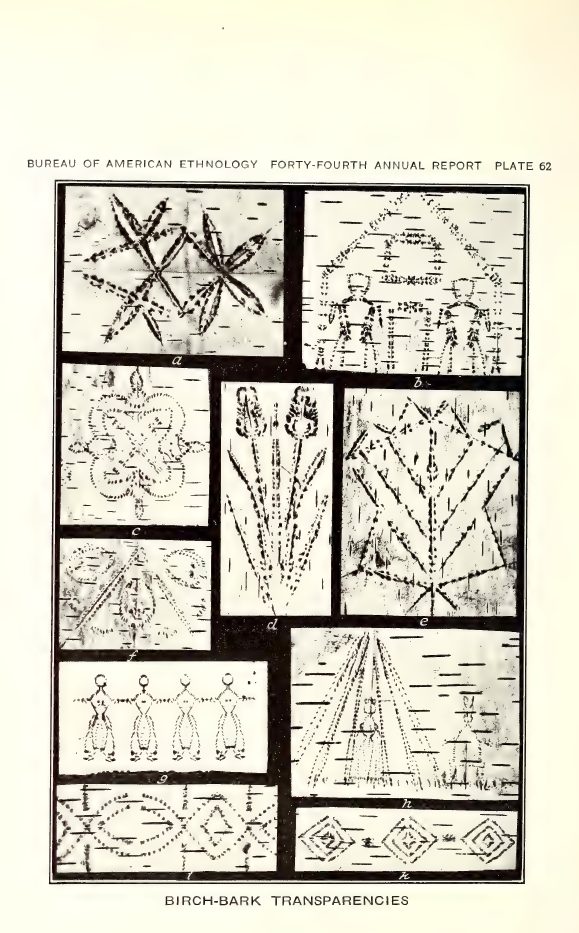
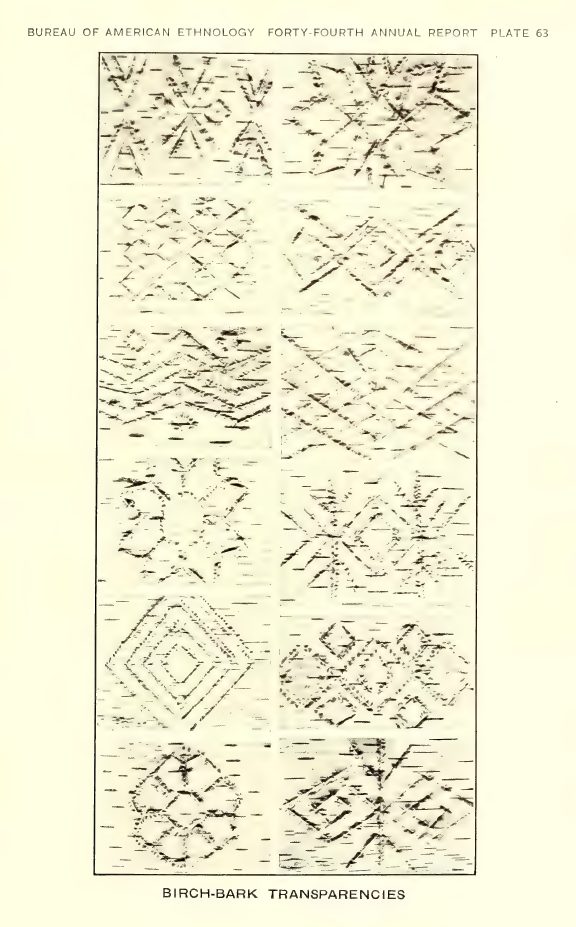
  22. 22Transparencies, bitten patterns and etched bark153

01 · page 18

Foreword

Densmore sets the frame. Plant specimens were identified by Paul C. Standley of the United States National Museum, the pharmacology notes came from Dr. W. W. Stockberger, and the interpreter who made the whole thing possible was Mrs. Mary Warren English. Most of the people who described food preparation were women.

IDEAS TO LEARN

  • The varied uses of plants by the Chippewa indicate the large extent to which they understood and utilized the natural resources of their environment. page 18
  • The collection of the material herewith presented would have been impossible without the cooperation of members of the Chippewa tribe. page 18
MACHINE-READ TEXT · 5 PARAGRAPHS

Uncorrected OCR from the Smithsonian scan. Spelling of Ojibwe words and botanical names may be garbled. The scan is the record.
02 · pages 19–20

Informants

The people who did the knowing, listed by community: White Earth, Ponsford, Mille Lac, Red Lake and the Manitou Rapids Reserve in Ontario. Each entry gives the everyday name, the Ojibwe name and its meaning. Nodinens is Little wind. Gagewin is Everlasting mist. Footnotes record who had died before the report went to press.

IDEAS TO LEARN

  • The purpose of this list is to identify the persons who chiefly contributed to the material herewith presented. The name given first is therefore the name by which the person is generally known. page 19
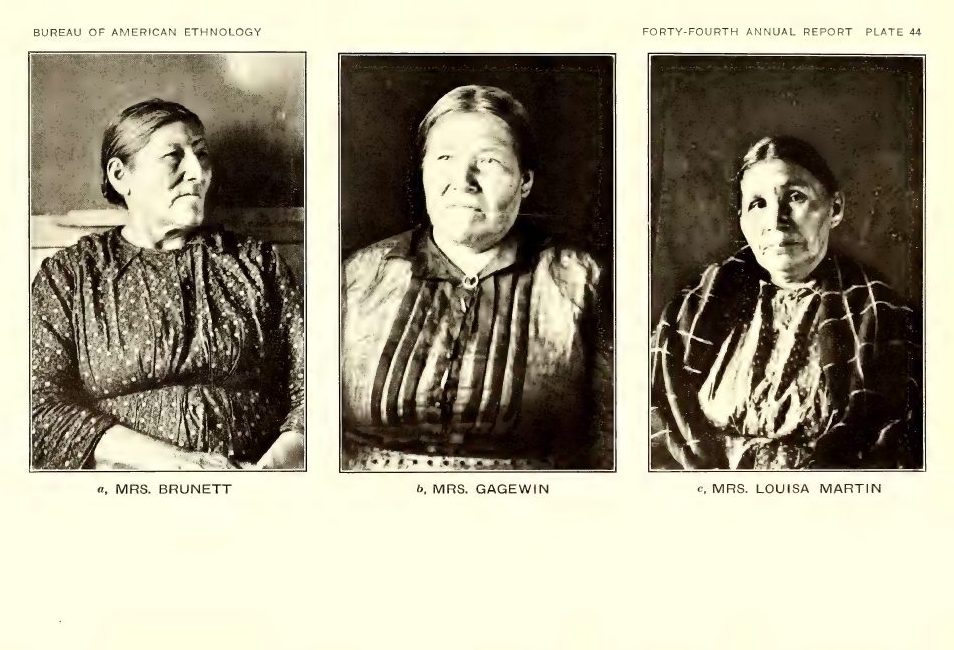
  • Mrs. Gagewin. Nised’nagan’ob. Nised, corruption of the French Lizett, or Elizabeth; Naganob, name of her father, who was chief at Fond du Lac, Minn. page 19
MACHINE-READ TEXT · 29 PARAGRAPHS

Uncorrected OCR from the Smithsonian scan. Spelling of Ojibwe words and botanical names may be garbled. The scan is the record.
03 · page 21

Phonetics

One page on how the Ojibwe words in the report are spelled. The alphabet does not capture every sound. c stands for sh, j for zh, dj for the j in judge, and doubled dots mark vowels said separately.

IDEAS TO LEARN

  • The vowels and consonants employed in this work do not represent every sound that occurs in the Chippewa language. page 21
MACHINE-READ TEXT · 4 PARAGRAPHS

Uncorrected OCR from the Smithsonian scan. Spelling of Ojibwe words and botanical names may be garbled. The scan is the record.
04 · page 24

Introduction

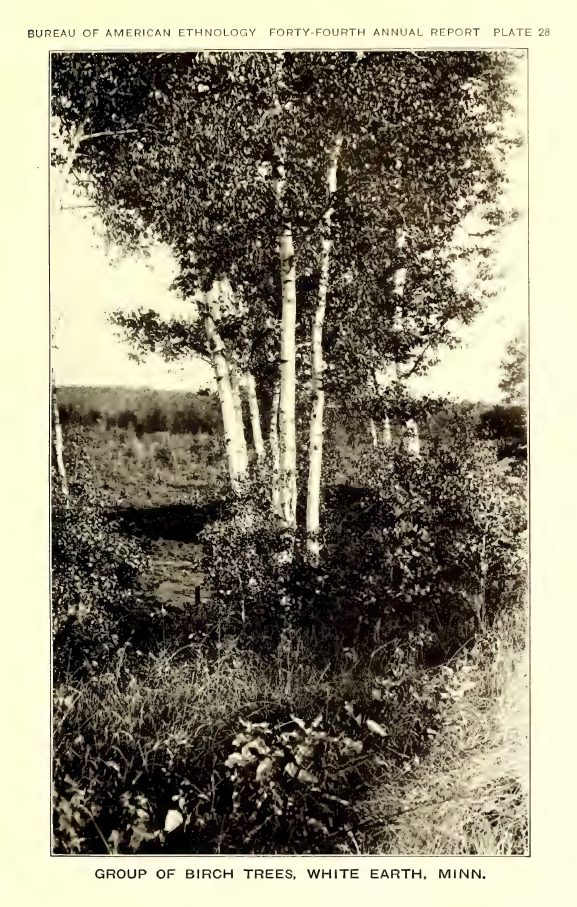
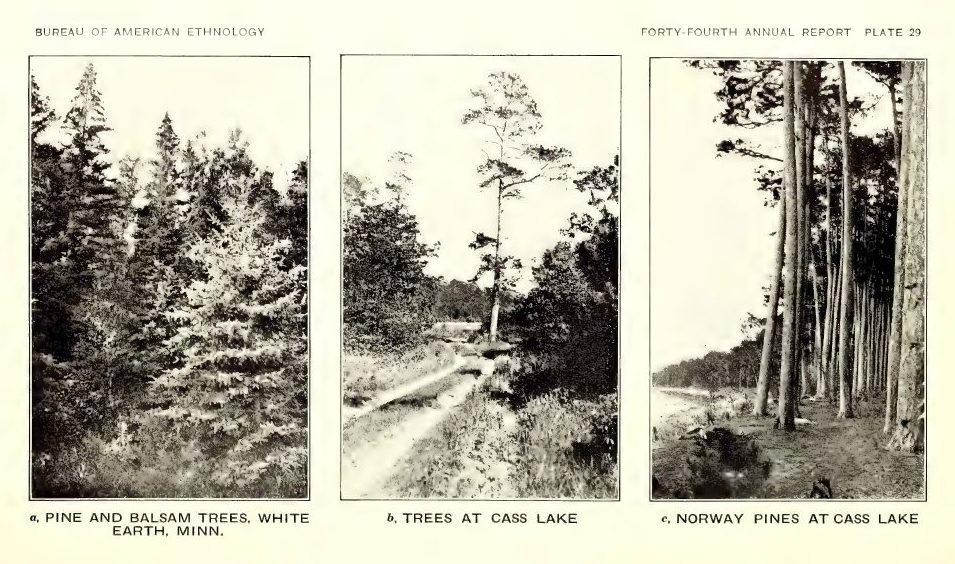
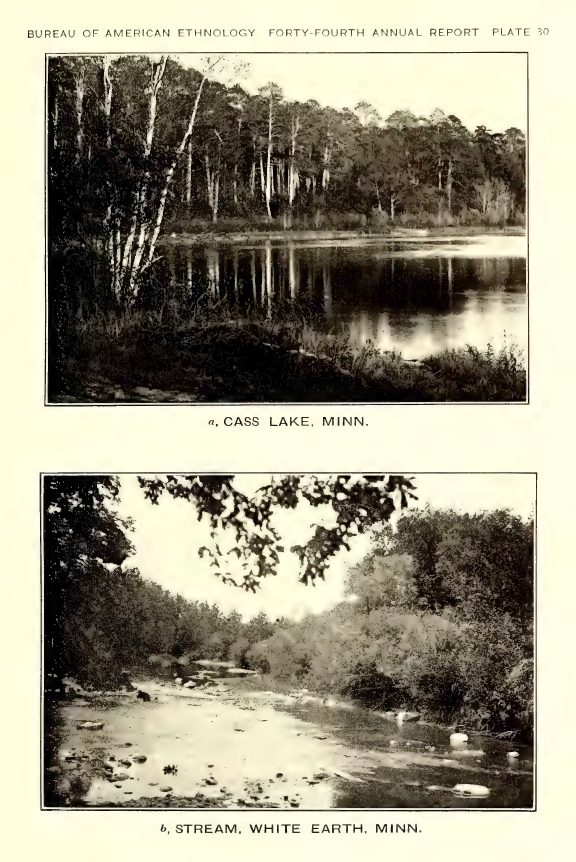
The country itself: birch groves on the hillsides, sugar maple tracts, forests of pine, cedar, balsam and spruce, lakes full of rice fields, pebbly streams. Densmore also explains why the same plant can have several names and uses depending on who is asked.

IDEAS TO LEARN

  • There are large tracts of sugar maples and forests of pine, cedar, balsam, and spruce. Many of the lakes contain rice fields, and there are pretty, pebbly streams winding their way among overhanging trees. page 24
MACHINE-READ TEXT · 2 PARAGRAPHS

Uncorrected OCR from the Smithsonian scan. Spelling of Ojibwe words and botanical names may be garbled. The scan is the record.
05 · pages 25–37

Plants arranged by botanical, common and native name

Three cross-reference tables of the same plants. These pages are printed sideways in the scan, so the machine-read text is unusable. Read them in the PDF. The note on page 297 explains why a medicine man might teach a plant without ever naming it.

IDEAS TO LEARN

  • It was also customary for a medicine man, when teaching the use of a plant, to show a specimen of the plant without giving it any name. Thus the identity of the plant was transmitted with more secrecy than would have been possible if a name had been assigned to it. page 36

These pages are tables printed sideways. Machine-read text is not usable here, so this chapter links straight to the scan.

06 · pages 38–41

Medicinal properties recognized by white medicine

Sixty-nine of the Chippewa plants also appeared in the United States Pharmacopoeia, the National Formulary or the dispensatories of the day. Each entry gives the botanical name, family and the action then attributed to it: balsam as stimulant and diuretic, bearberry leaves as antiseptic diuretic, wild cherry bark as sedative. A 1928 snapshot of one medicine looking at another.

IDEAS TO LEARN

  • The following 69 plants used by the Chippewa are regarded as medicinal by white people, although opinion as to their therapeutic value varies greatly. page 38
  • Ledum groenlandicum Oeder. Labrador tea. The leaves are expectorant and tonic. They are said to have been employed instead of tea leaves during the Revolutionary War. page 40
MACHINE-READ TEXT · 72 PARAGRAPHS

Uncorrected OCR from the Smithsonian scan. Spelling of Ojibwe words and botanical names may be garbled. The scan is the record.
07 · pages 42–44

Principal active medicinal constituents

The chemistry, plant by plant, as it was understood in 1928. Balsam is a turpentine of 24 parts essential oil and 60 parts resin. Wintergreen carries methyl salicylate. Bloodroot holds the alkaloids chelerythrine and sanguinarine. Many entries simply read Undetermined, which is its own kind of honesty.

IDEAS TO LEARN

  • Abies balsamea. Constituents: A true turpentine consisting of 24 parts essential oil and 60 parts resin. page 42
  • Sanguinaria canadensis. Constituents: The alkaloid chelerythrine, sanguinarine, gamma-homochelidonine and protopine. page 44
MACHINE-READ TEXT · 38 PARAGRAPHS

Uncorrected OCR from the Smithsonian scan. Spelling of Ojibwe words and botanical names may be garbled. The scan is the record.
08 · pages 45–46

Plants as food

A people subsisting chiefly on vegetable products and fish. Gardens were part of the working year and the harvest went into caches. Fish were dried or frozen, meat was pounded and mixed with tallow, rabbits were snared through winter, and every part of a bear was eaten or used.

IDEAS TO LEARN

  • Thus it is seen that the Chippewa were a people subsisting chiefly on vegetable products and fish, though they secured deer and other animals by hunting. page 45
  • The bear was an especially useful animal, as all parts of it were either eaten or utilized. page 45
MACHINE-READ TEXT · 8 PARAGRAPHS

Uncorrected OCR from the Smithsonian scan. Spelling of Ojibwe words and botanical names may be garbled. The scan is the record.
09 · pages 47–55

Making maple sugar

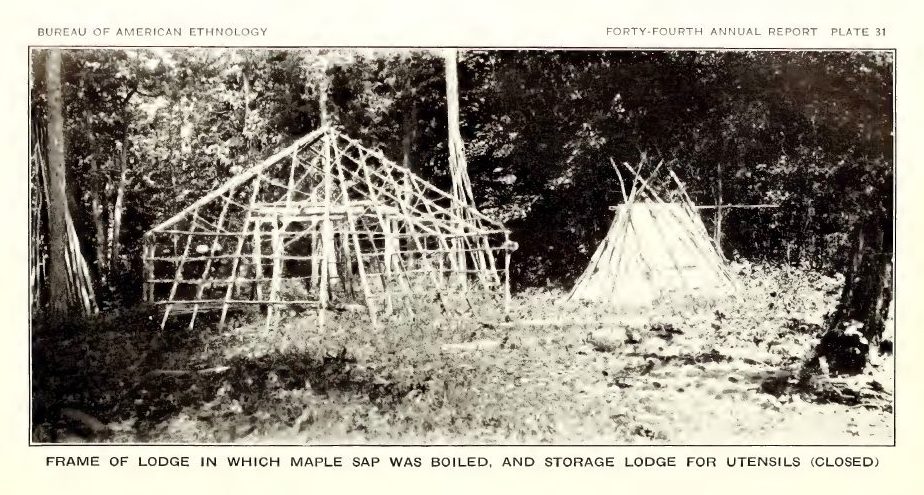
Maple sugar and wild rice were the two most important vegetable foods. Each family had its own sugar bush, sized not by trees but by taps, nine hundred being average. The season opened in mid March and ran about a month. Sap boiled all night, a spruce branch calmed a kettle that boiled too fast, deer tallow kept the sugar soft when it grained. Sugar was stored in birch-bark makuks and cones and used as seasoning on everything, long before salt.

IDEAS TO LEARN

  • The two most important vegetable foods were maple sugar and wild rice. The obtaining of these commodities was attended with much pleasure, though the temporary camps were busy and there was work for young and old. page 47
  • The capacity or size of a sugar bush was not estimated by the number of maple trees but by the number of ‘taps,’ as it was not unusual to make two or three taps in a large tree. Nine hundred taps was an average size. page 52
  • If a kettle boiled too rapidly a branch of spruce attached to a stick was dipped into the froth. The motion was little more than a brushing of the froth with the spruce, but the bubbling at once subsided. page 54
  • When it became thick, small pieces of deer tallow were put in it. This was said to make the sugar soft and not brittle. page 55
MACHINE-READ TEXT · 43 PARAGRAPHS

Uncorrected OCR from the Smithsonian scan. Spelling of Ojibwe words and botanical names may be garbled. The scan is the record.
10 · pages 56–69

Gathering wild rice

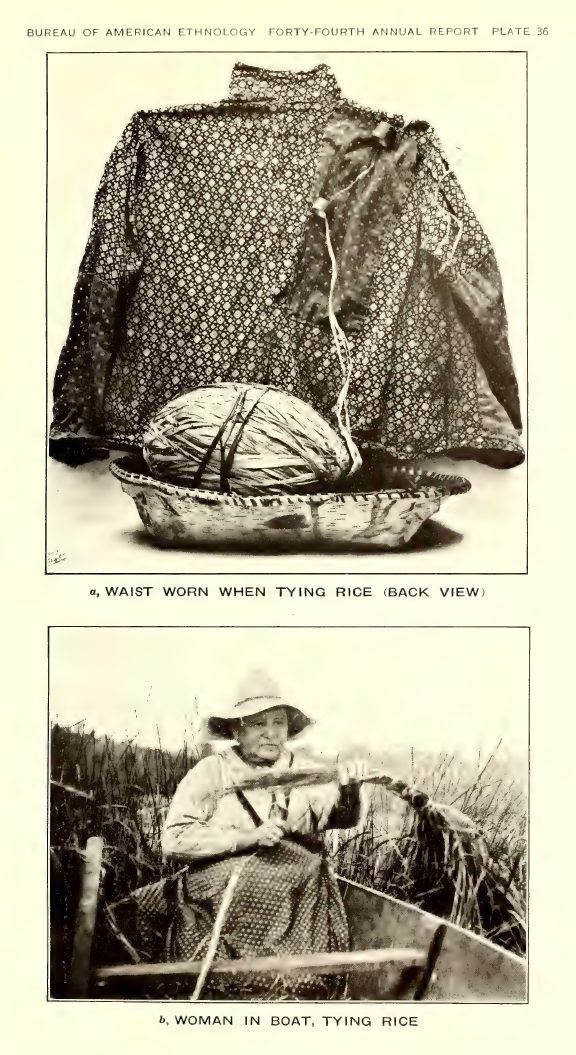
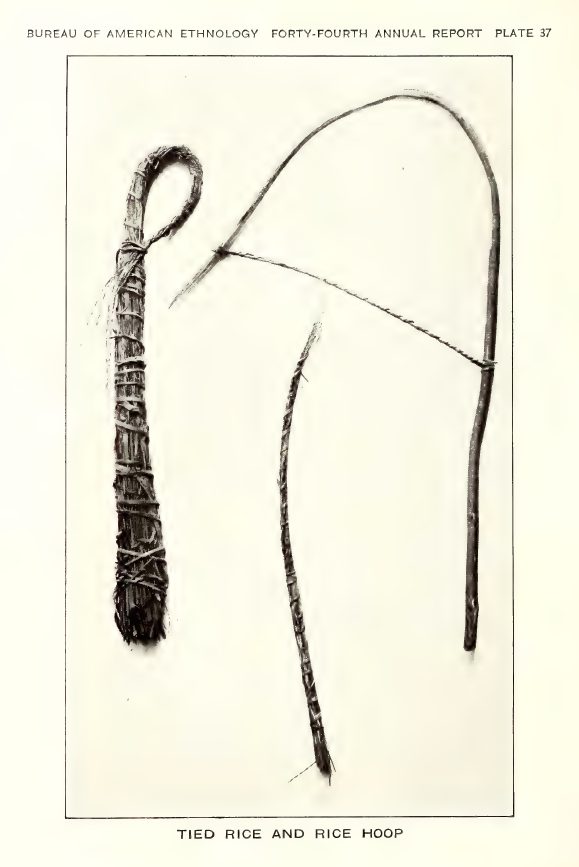
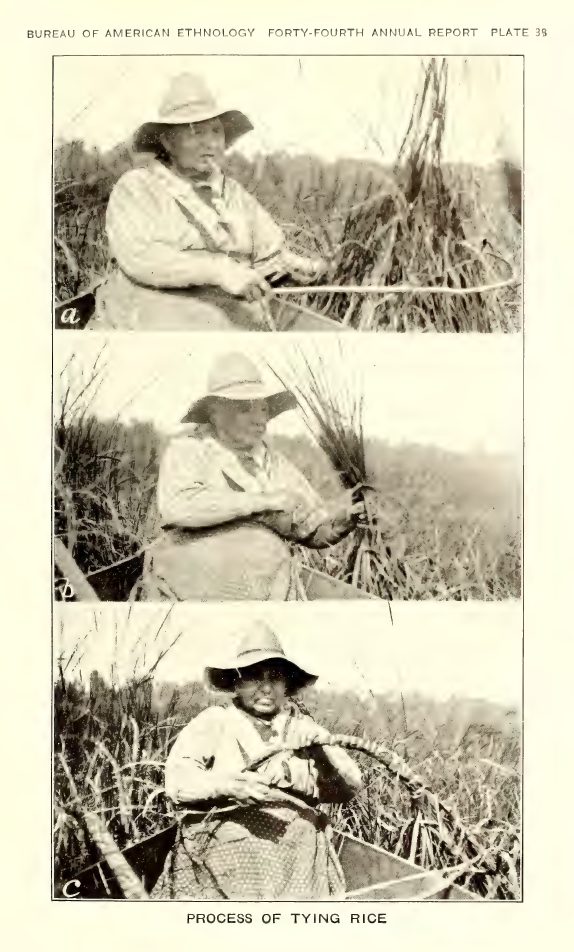
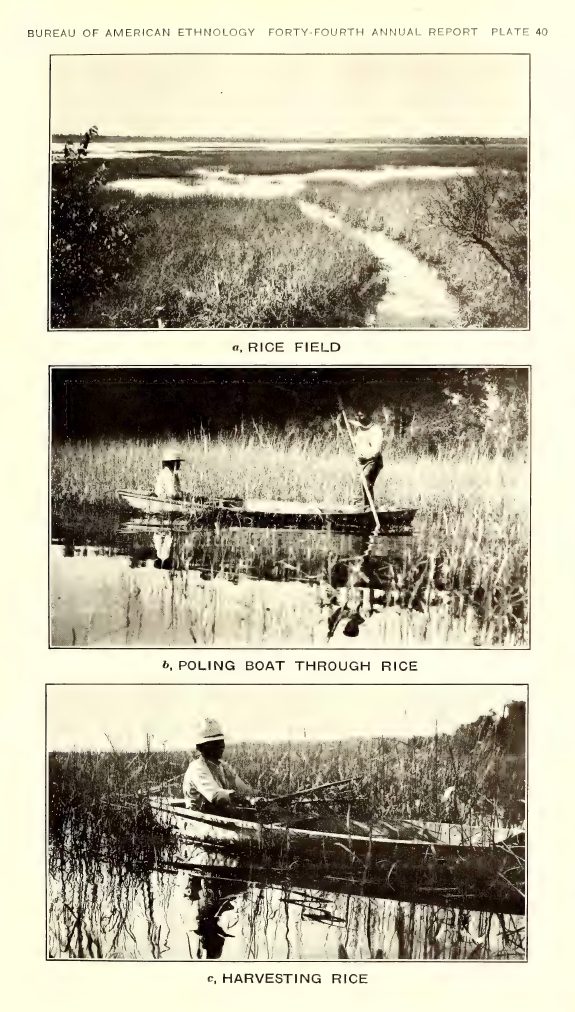
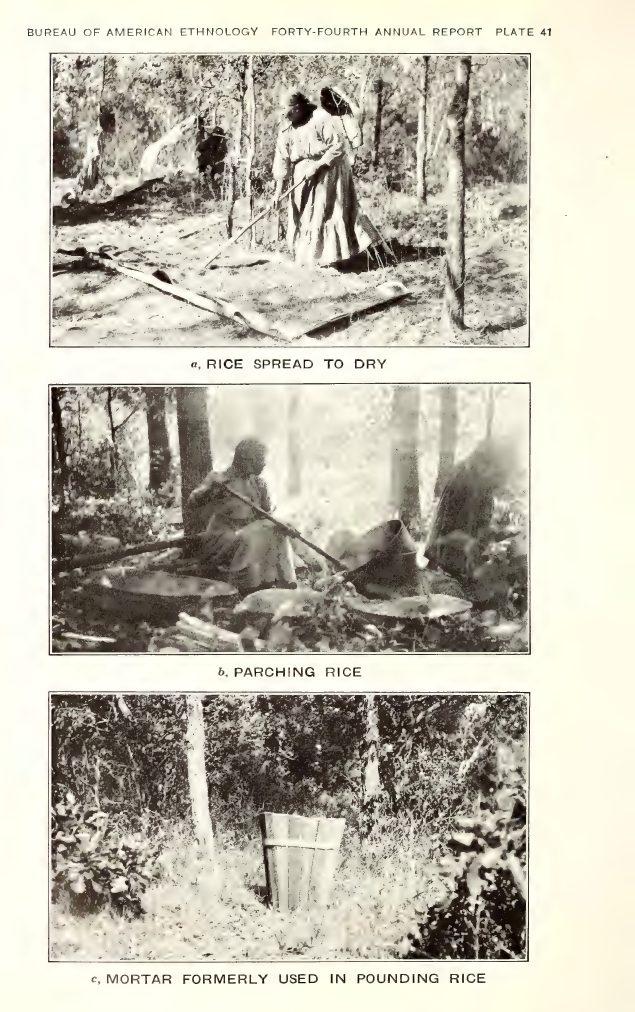
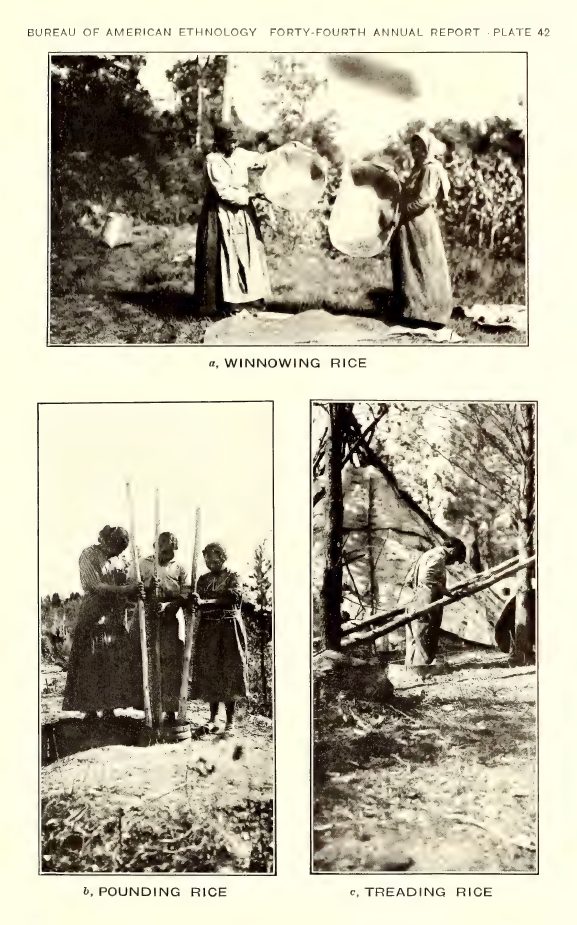
Each family held a portion of a rice field the way it held a sugar bush. About ten days before the rice ripened a woman claimed her portion by tying the standing stalks into sheaves with untwisted basswood fiber. At harvest a man poled the canoe while a woman knocked the kernels in. Then the rice was dried, parched, pounded, winnowed and trodden in clean moccasins.

IDEAS TO LEARN

  • The portion of a rice field was outlined by stakes, and a woman established her claim to it by going to the field about 10 days before the rice was ripe and tying portions of it in small sheaves. page 56
  • A canoeful of rice was considered a day’s gathering. page 57
  • It was considered a test of a good rice gatherer to free the ripe rice kernels without dislodging those which were unripe. Thus it was possible to go over the same part of a rice field several times at intervals of a few days. page 57
  • The treading was done by a man wearing clean moccasins, and the poles were for him to rest his arms upon during the process. page 69
MACHINE-READ TEXT · 21 PARAGRAPHS

Uncorrected OCR from the Smithsonian scan. Spelling of Ojibwe words and botanical names may be garbled. The scan is the record.
11 · pages 70–71

Beverages, seasonings and cereals

The Chippewa did not commonly drink water met on the trail. They boiled it and made a drink of it: Labrador tea, wintergreen, cherry twigs, raspberry twigs. One man described a woman who dried more than twenty kinds of flowers by the first of July for a winter drink. Maple sugar was the seasoning for everything. Salt arrived by treaty in 1847 and some elders never took to it.

IDEAS TO LEARN

  • It is interesting to note that the Chippewa did not commonly drink water encountered in traveling but boiled it, making some of the following beverages. page 70
  • He said that by the first of July she had more than twenty varieties. In the fall she pulverized them and stored them. page 70
  • In the early days the Minnesota Chippewa had no salt and some of the older Indians have not yet acquired a taste for it. page 71
MACHINE-READ TEXT · 28 PARAGRAPHS

Uncorrected OCR from the Smithsonian scan. Spelling of Ojibwe words and botanical names may be garbled. The scan is the record.
12 · pages 72–74

Vegetables and berries

Corn parched, pounded to meal and made into soup with deer tallow, or turned to hominy with hardwood-ash lye. Pumpkins and squash cut into rings and dried. Wild potatoes, arrowhead, marsh marigold, milkweed flowers, cattail root. Then the berries: blueberries dried in the sun, chokecherries pounded stones and all, cranberries, grapes, and Juneberries, the simplest form of refreshment.

IDEAS TO LEARN

  • These are called ‘Juneberries’ by the Chippewa and are found abundantly in their country. They are considered the simplest form of refreshment. ‘Take some Juneberries with you,’ is a common saying among the Chippewa. page 74
  • All dried berries were boiled when used, and either seasoned with maple sugar or combined with other foods. page 75
MACHINE-READ TEXT · 33 PARAGRAPHS

Uncorrected OCR from the Smithsonian scan. Spelling of Ojibwe words and botanical names may be garbled. The scan is the record.
13 · pages 75–77

Plants as medicine: treatment

How a remedy came to be known and kept. The Midewiwin taught that every tree, bush and plant has a use. Remedies were individual property, not general knowledge. Members follow the bear path from one degree to the next and some of the best remedies were said to come from the bear. Dreams, purchase and inheritance were the other routes.

IDEAS TO LEARN

  • It is a teaching of the Midewiwin that every tree, bush, and plant has a use. page 75
  • The remedies are individual, not general, and an individual when questioned invariably replies, ‘I can tell you about my own medicines. I do not know about other peoples’ medicines nor their uses of the same plants.’ page 76
  • It is said that members of the Midewiwin ‘follow the bear path’ in proceeding from a lower to a higher degree in the society and that some of the best Mide remedies were received from the bear. page 76
MACHINE-READ TEXT · 25 PARAGRAPHS

Uncorrected OCR from the Smithsonian scan. Spelling of Ojibwe words and botanical names may be garbled. The scan is the record.
14 · pages 80–84

Gathering and preparing remedies

Tobacco went into the ground beside the plant before it was dug, and the digger spoke to it. Roots were gathered before the sap rose or after it fell, bark when the sap was up. Some roots had a strongest part, the elbow of dogbane. Names came from place, appearance, taste or the part used. Combinations ran to twenty herbs. Doses were a large swallow, and one careful practitioner’s pail held about a pint.

IDEAS TO LEARN

  • You were allowed to grow here for the benefit of mankind, and I give you this tobacco to remind you of this, so that you will do the best you can for me. page 80
  • Bark was gathered when the sap was in the tree but roots intended for future medicinal use were gathered before the sap started in the spring or after it had gone down in the fall. page 81
  • Thus in dogbane the part preferred was the elbow of the root, the plant having a root which descends straight downward for 15 to 18 inches and then turns sharply to one side. page 81
  • The Chippewa use combinations of herbs, sometimes as many as 20 vegetable substances being combined in one remedy. page 84
  • Liquid medicine was not measured when taken. A ‘large swallow’ constituted an average dose. page 84
MACHINE-READ TEXT · 27 PARAGRAPHS

Uncorrected OCR from the Smithsonian scan. Spelling of Ojibwe words and botanical names may be garbled. The scan is the record.
15 · pages 85–90

Administration, appliances and surgery

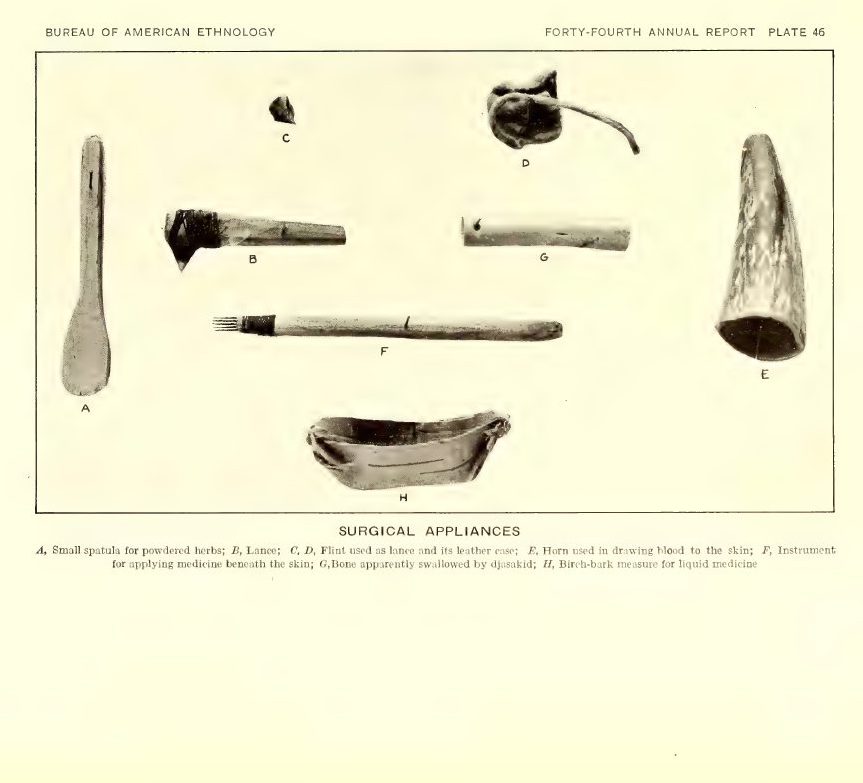
Seven ways to give a remedy externally and seven internally, from poultice and steam to pipe and enema. Non-plant remedies: deer tallow, bear grease, clamshell for mixing. Appliances: the sweat lodge, steam over hot stones for headache, a strip of slippery elm bark in place of an emetic, a deer bladder as syringe. Surgery: bloodletting, gashes made with flint or glass, cupping with a horn, a needle instrument, and Main’gans’ own account of the knife that amputated his frozen limbs when he was a boy.

IDEAS TO LEARN

  • Remedies were administered externally in the following manner: (1) Fresh roots or leaves were macerated and applied. (2) Dried roots or leaves were pulverized, prepared in the form of a decoction, and applied. page 85
  • The patient covered his head and shoulders with a blanket, inclosing the stones and inhaling the fumes. A mixture of many varieties of flowers was said to be an agreeable preparation for this use. page 86
  • The writer saw a woman whose elbow had been cut with 15 or 20 gashes about a quarter of an inch long. This treatment was given for a sprain, her elbow having swollen to twice its natural size. page 87
MACHINE-READ TEXT · 36 PARAGRAPHS

Uncorrected OCR from the Smithsonian scan. Spelling of Ojibwe words and botanical names may be garbled. The scan is the record.
16 · pages 91–125

Medicinal plants, the tabulated list

Thirty-five pages of tables: ailment, plant, part used, preparation, dose, and the informant’s own words. This is the table the field list on the home page is built from. The pages are printed sideways in the scan, so read them in the PDF or use the field list.

IDEAS TO LEARN

  • This root grows straight downward and then turns sharply. The strongest medicinal value is at the elbow where the root turns. page 94

These pages are tables printed sideways. Machine-read text is not usable here, so this chapter links straight to the scan.

17 · pages 126–131

Dyes

A vegetable substance for the color and a mineral one to set it. Porcupine quills took dye best and held it longest, rushes worst. Butternut inner bark gave black. Red-osier dogwood inner bark with birch bark and cedar ash gave red. Recipes are given with the informant’s quantities.

IDEAS TO LEARN

  • The general process of dyeing among the Chippewa consisted in the use of a vegetable substance to secure a color and of a mineral substance to ‘set’ it. page 126
  • Porcupine quills were the articles most easily dyed, and they retain their color longest. Rushes are the hardest material to dye. page 126
MACHINE-READ TEXT · 73 PARAGRAPHS

Uncorrected OCR from the Smithsonian scan. Spelling of Ojibwe words and botanical names may be garbled. The scan is the record.
18 · pages 132–133

Charms

Herbs believed to act by their presence, without contact. To be effective they had to be talked and prayed over when gathered and when used. Densmore sorts them into classes: love, worldly goods, safety, animals, evil, and protection against it. The same plant could be a charm and a medicine: dogbane, wild pea, Seneca snakeroot.

IDEAS TO LEARN

  • In order to make these substances effective it was considered necessary to ‘talk and pray’ over them when they were used, and, in the case of an herb, to ‘talk and pray’ when it was gathered. page 132
  • In addition to the vegetable substances believed to have an effect when administered internally or externally there were herbs and roots believed to act by their presence independent of actual contact. page 82
MACHINE-READ TEXT · 24 PARAGRAPHS

Uncorrected OCR from the Smithsonian scan. Spelling of Ojibwe words and botanical names may be garbled. The scan is the record.
19 · pages 134–137

Useful and decorative arts

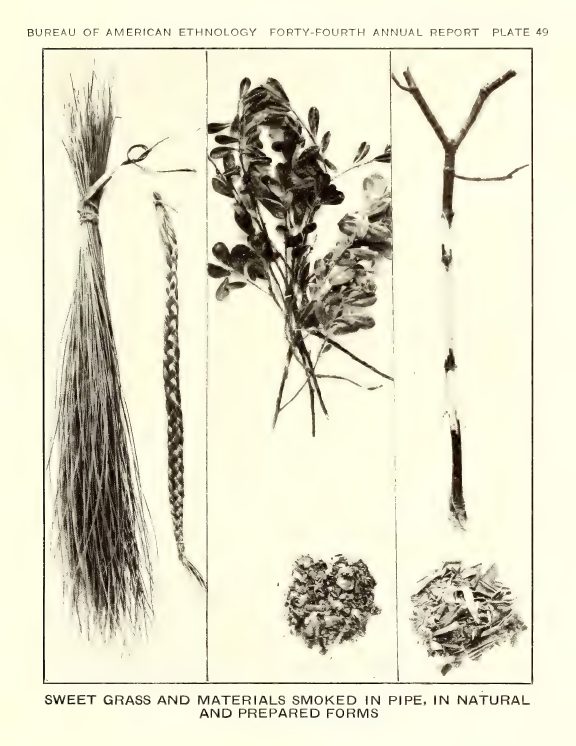
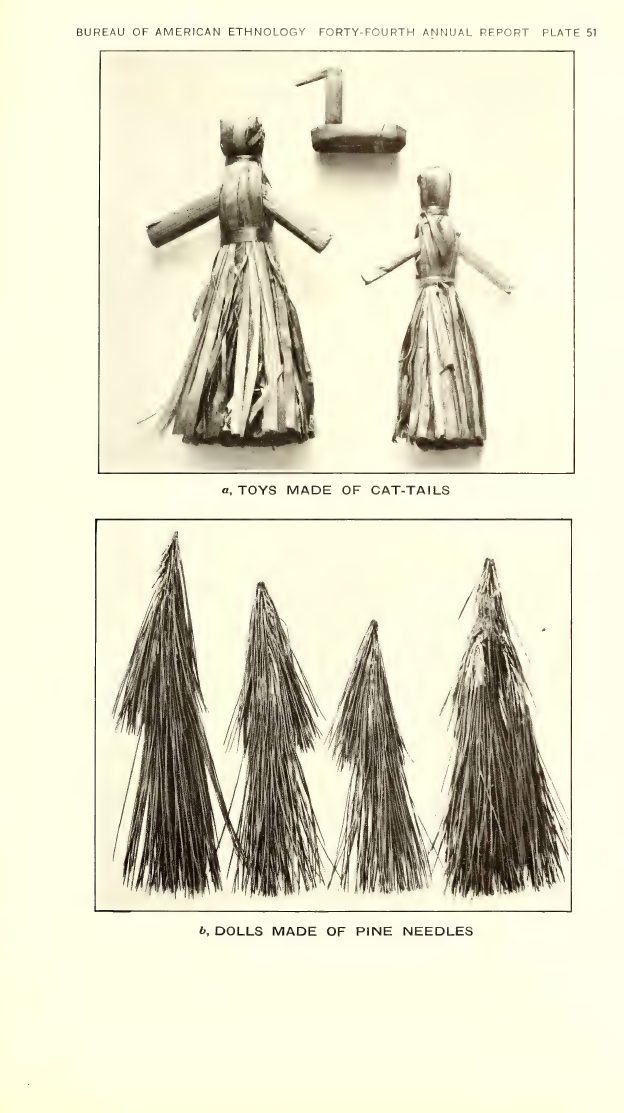
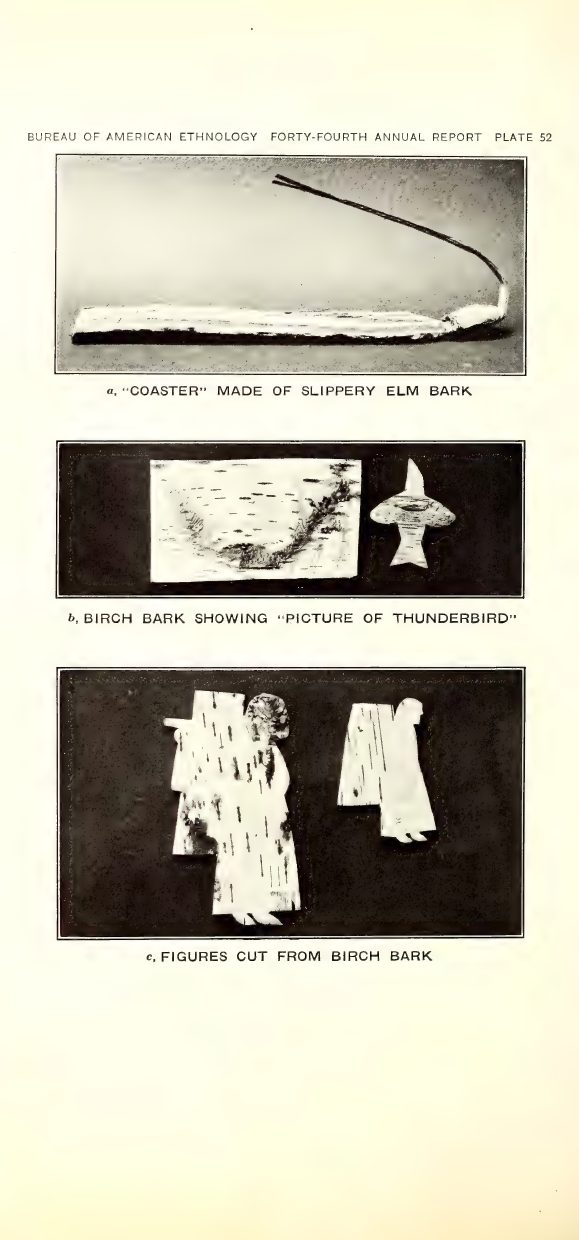
Twine from basswood inner bark was one of the most important articles in Chippewa economic life. Bulrush mats woven on frames, reed racks for drying berries, thorn-apple awls, spruce gum for caulking, tamarack root for sewing canoes, cedar boughs for bedding. Toys: onion-stem whistles, elm-bark dolls, cattail ducks blown across still water, pine-needle figures, a slippery-elm coaster. Sweet grass was ceremonial, economic and simply pleasant.

IDEAS TO LEARN

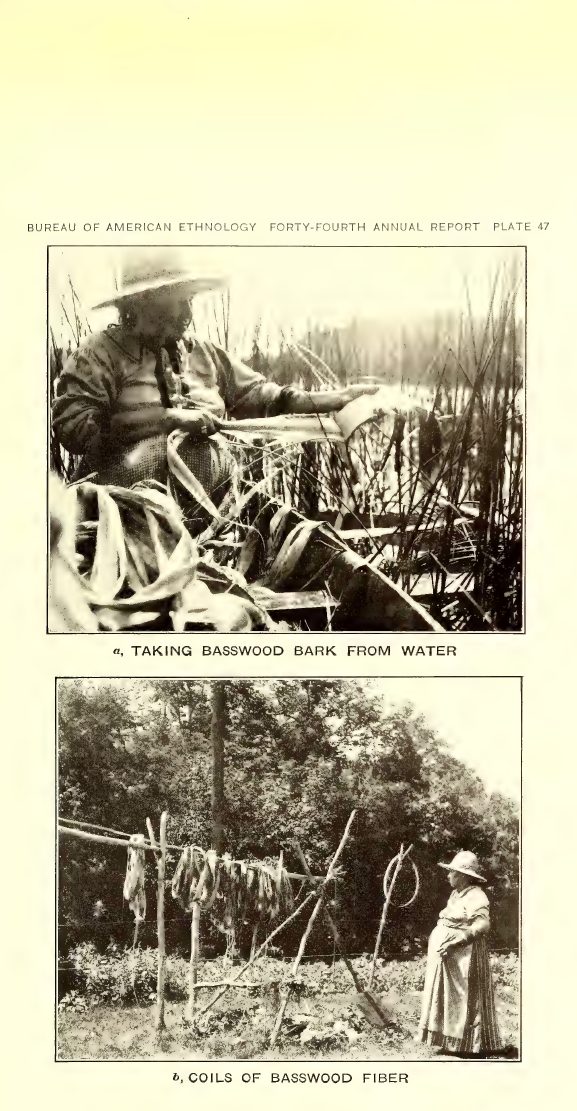
  • Twine was one of the most important articles in the economic life of the Chippewa. It was made chiefly from the inner bark (fiber) of the basswood. page 135
  • The children themselves cut the stems of the wild onion and made little whistles. page 136
  • Three types of uses of sweet grass were noted among the Chippewa, i. e., ceremonial, economic, and pleasurable. page 137
MACHINE-READ TEXT · 44 PARAGRAPHS

Uncorrected OCR from the Smithsonian scan. Spelling of Ojibwe words and botanical names may be garbled. The scan is the record.
20 · pages 144–149

The sacred trees and the Winabojo legends

Birch and cedar were held sacred for two joined reasons: their great usefulness and their connection with Winabojo. Mrs. Razer told the legends. Winabojo and the birch tree begins with an old woman and a foundling girl on the shore of Lake Superior and ends with Winabojo sheltering from the thunderbirds inside a hollow birch, which is why the tree protects and preserves. The cedar story follows Grand Medicine men to the spirit land and back.

IDEAS TO LEARN

  • The birch and the cedar were regarded as ‘sacred’ by the Chippewa. The two reasons for this ‘sacredness’ are closely connected. One is the great usefulness of these trees to the Chippewa and the other is their connection with Winabojo. page 144
  • There was once an old woman living all alone on the shore of Lake Superior. She had a little girl living with her whom she called her daughter, though she did not know exactly where the child came from. page 144
  • As long as the world stands this tree will be a protection and benefit to the human race. If they want to preserve anything they must wrap it in birch bark and it will not decay. page 147
MACHINE-READ TEXT · 50 PARAGRAPHS

Uncorrected OCR from the Smithsonian scan. Spelling of Ojibwe words and botanical names may be garbled. The scan is the record.
21 · pages 149–153

Gathering bark and the articles made from it

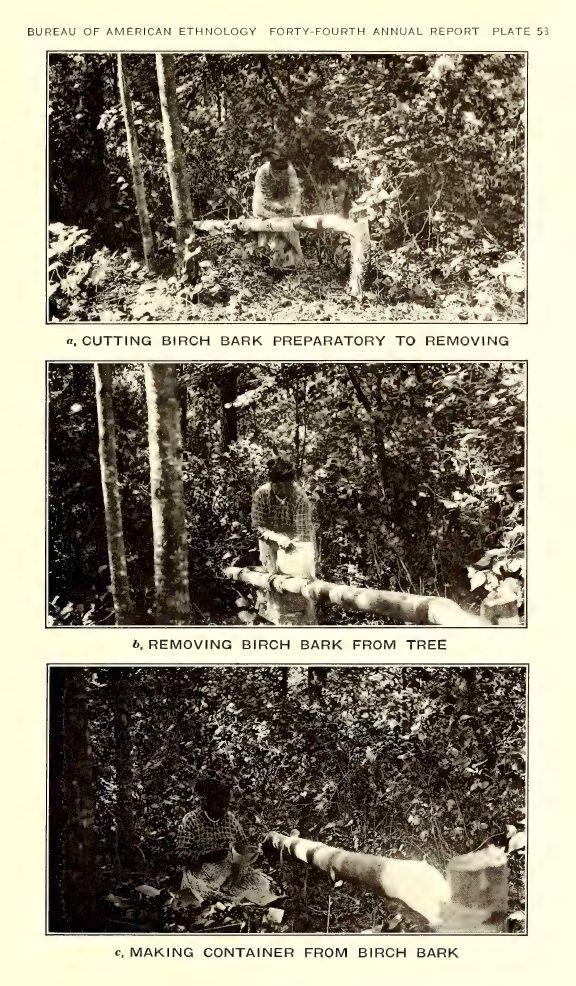
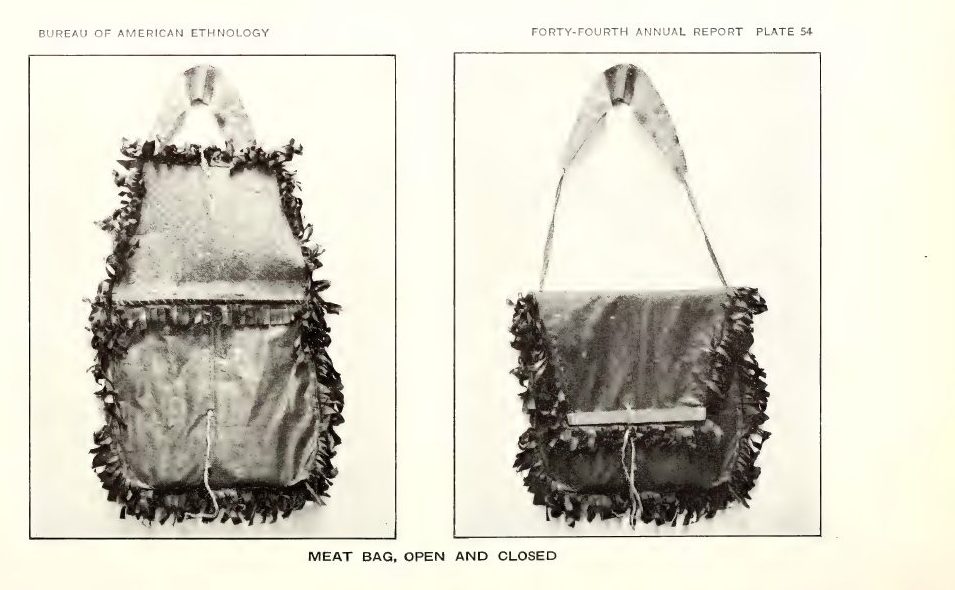
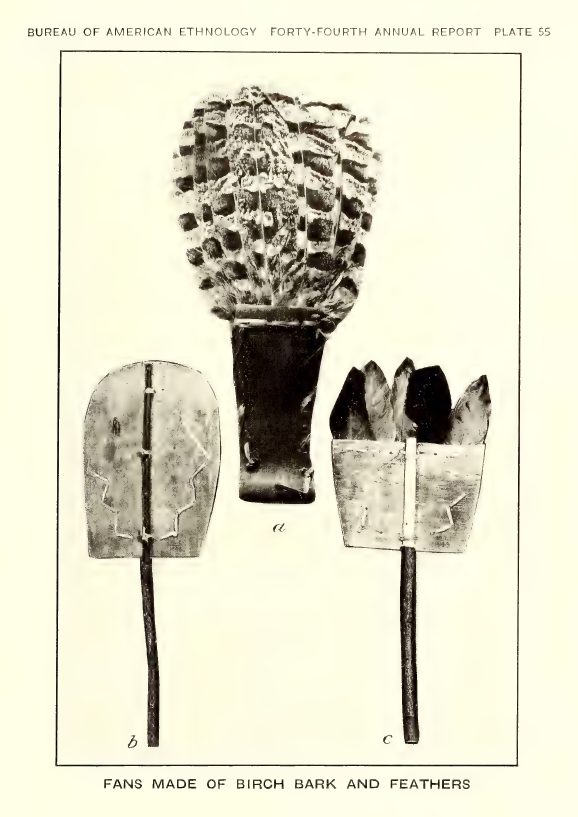
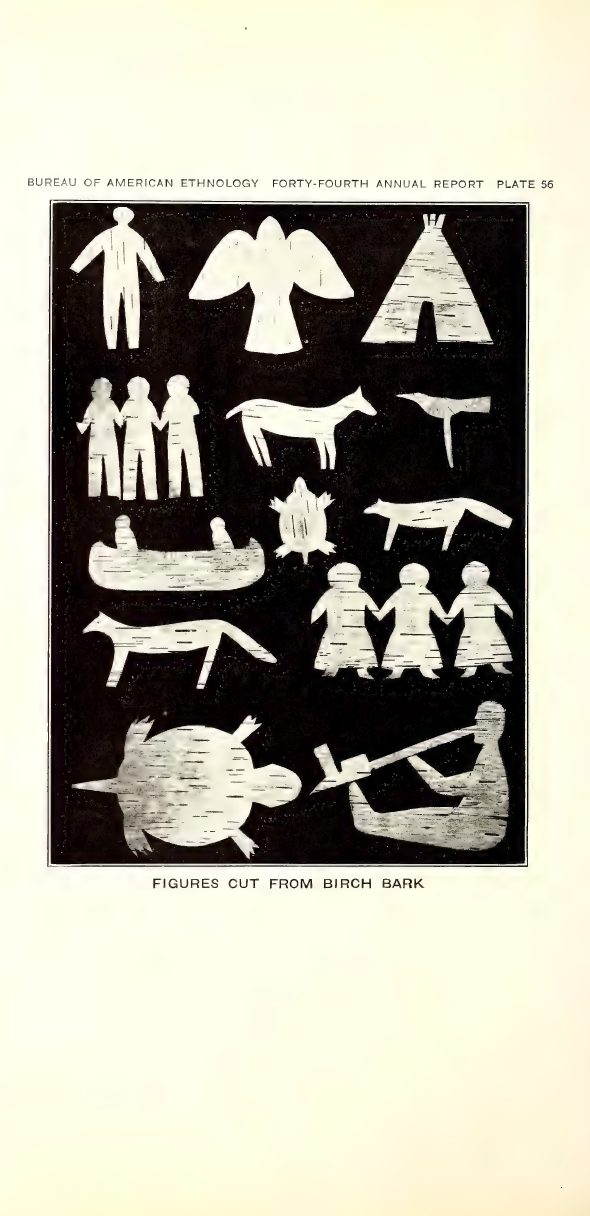
Bark was taken in June or early July with a simple ceremony and tobacco in the ground. Densmore watched Mrs. Razer fell a birch. Sheets were tied in packs of a hundred with fresh basswood strips. Heavy bark, six to nine layers thick, made canoes. The thinnest wrapped small packets like tissue. Makuks for sugar and berries, cones, dishes, cooking vessels, roof rolls, meat bags, fans, torches, cut figures and beadwork patterns.

IDEAS TO LEARN

  • Mrs. Razer habitually follows the old custom of placing tobacco in the ground when gathering any of the products of nature, so the old ceremony was performed in all sincerity. page 150
  • The heaviest bark, from large trees, comprises six to nine distinct layers and is so strong that it could be made into canoes carrying many persons. page 151
  • Birch bark can be unrolled only by exposing it to the heat of a fire. When heated it becomes pliable, and retains any form in which it is placed when thus softened. page 151
  • It was said that when a woman was cutting birch bark she often ‘sharpened her knife’ by drawing it across her hair. page 151
MACHINE-READ TEXT · 35 PARAGRAPHS

Uncorrected OCR from the Smithsonian scan. Spelling of Ojibwe words and botanical names may be garbled. The scan is the record.
22 · pages 153–172

Transparencies, bitten patterns and etched bark

The most primitive form of Chippewa art: a leaf or a thin sheet of birch bark, folded and indented with the eyeteeth, unfolded and held up to the light. A winter-evening pastime in the wigwam and the sugar camp, and a source of beadwork patterns. Densmore collected more than two hundred from older women at White Earth, Red Lake and Manitou Rapids. The chapter closes with a story about a wife who bit bark instead of gathering it, and with etched and self-patterned bark taken in early spring.

IDEAS TO LEARN

  • The most primitive form of Chippewa art is that in which the only material is a broad leaf or thin piece of birch bark and the only tools are human teeth and deft fingers. page 153
  • It formed a pastime of the winter evenings, when the young people were seated in the wigwam with no other light than the fire, and it was especially practiced during the sugar camp. page 160
  • The patterns here illustrated were selected from a collection of more than 200, obtained from the older women at White Earth and Red Lake in Minnesota, and the Manitou Rapids Reserve in Canada. page 170
MACHINE-READ TEXT · 34 PARAGRAPHS

Uncorrected OCR from the Smithsonian scan. Spelling of Ojibwe words and botanical names may be garbled. The scan is the record.
03

THE PLATES

All 36 photographic plates in the report, 28 through 63, cropped from the scan. Tap to enlarge. Captions are the report's own.

PLATE 28 Group of birch trees, White Earth, Minn. page 22
PLATE 29 a, Pine and balsam trees, White Earth, Minn.; b, Trees at Cass Lake; c, Norway pines at Cass Lake page 23
PLATE 30 a, Cass Lake, Minn.; b, Stream, White Earth, Minn. page 48
PLATE 31 Frame of lodge in which maple sap was boiled, and storage lodge for utensils (closed) page 49
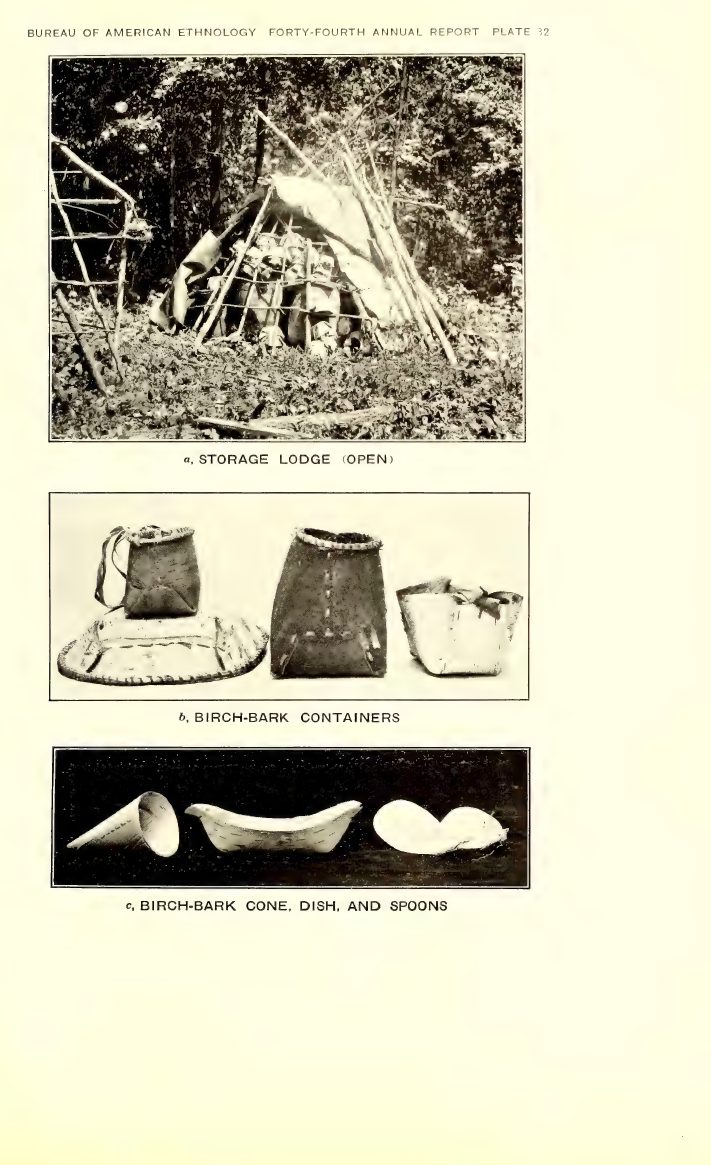
PLATE 32 a, Storage lodge (open); b, Birch-bark containers; c, Birch-bark cone, dish, and spoons page 50
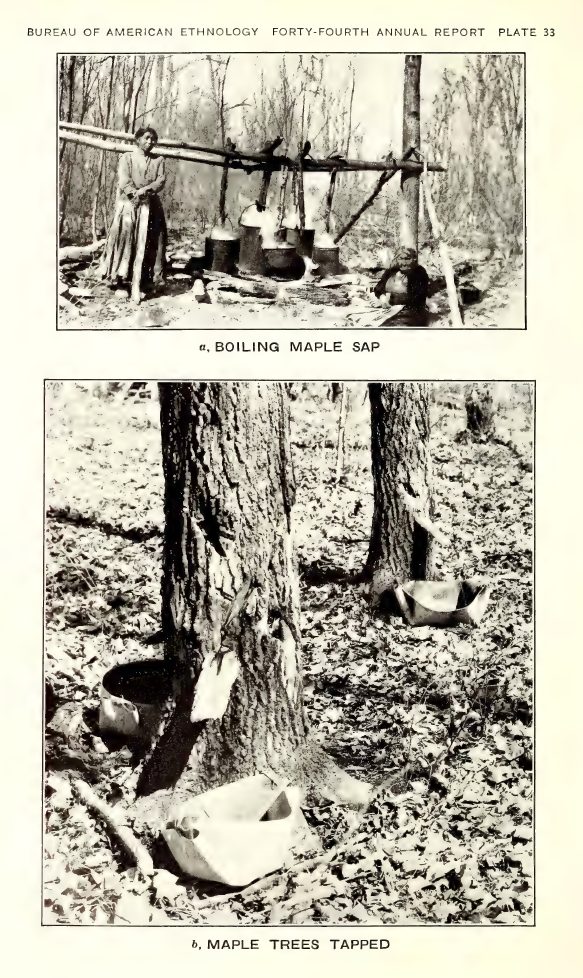
PLATE 33 a, Boiling maple sap; b, Maple trees tapped page 51
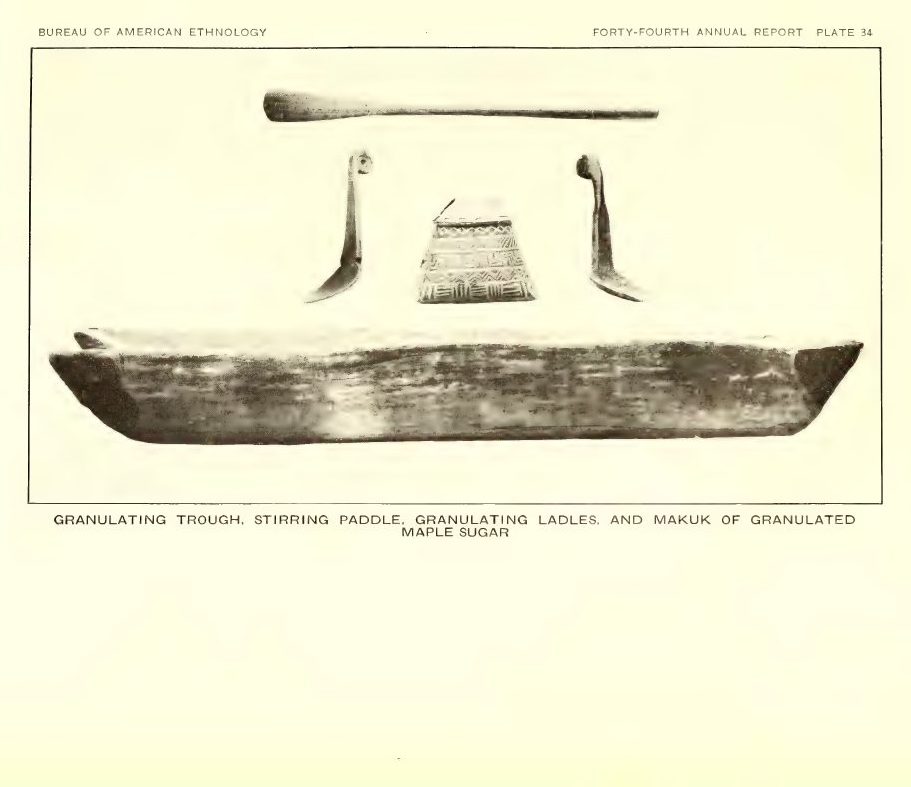
PLATE 34 Granulating trough, stirring paddle, granulating ladles, and makuk of granulated maple sugar page 58
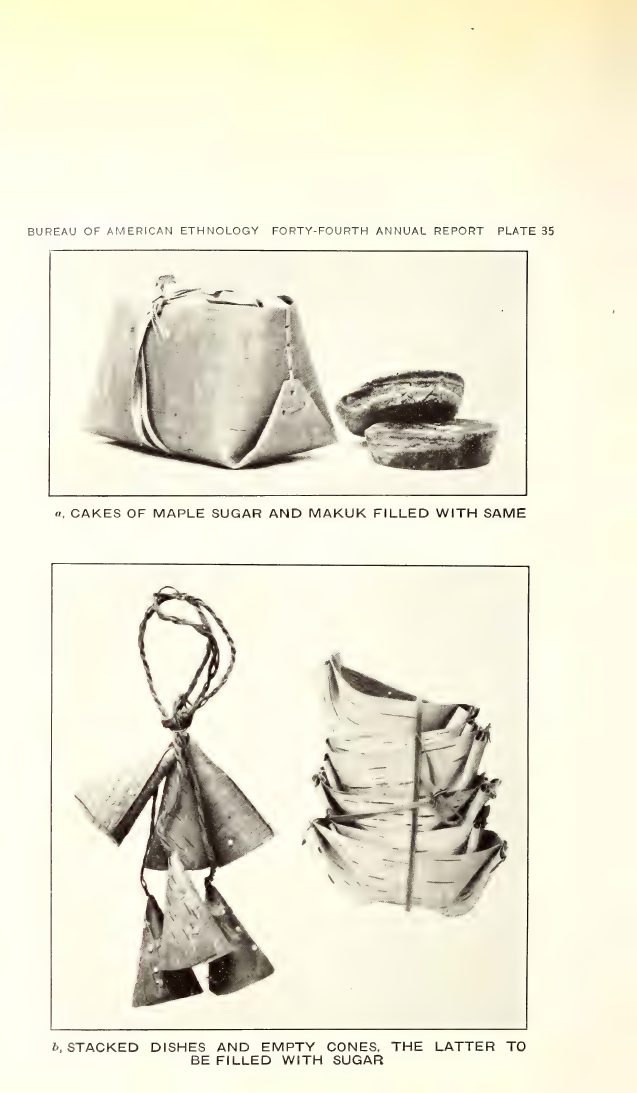
PLATE 35 a, Cakes of maple sugar and makuk filled with same; b, Stacked dishes and empty cones, the latter to be filled with sugar page 59
PLATE 36 a, Waist worn when tying rice (back view); b, Woman in boat, tying rice page 60
PLATE 37 Tied rice and rice hoop page 61
PLATE 38 Process of tying rice page 62
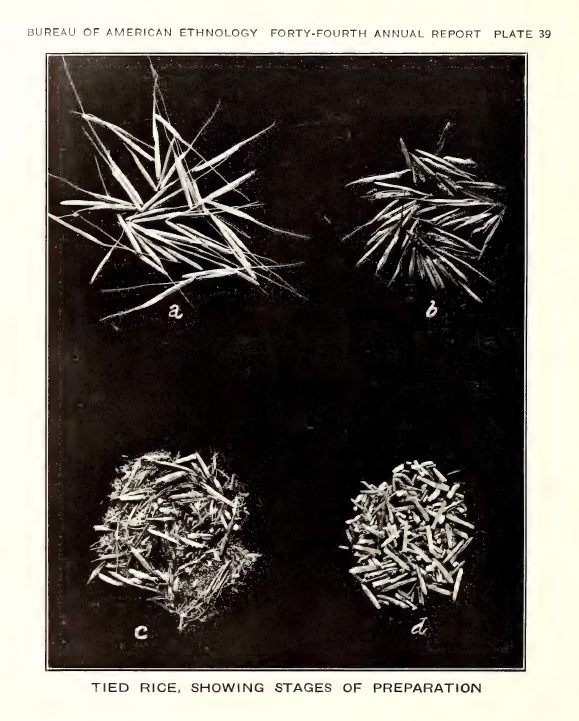
PLATE 39 Tied rice, showing stages of preparation page 63
PLATE 40 a, Rice field; b, Poling boat through rice; c, Harvesting rice page 64
PLATE 41 a, Rice spread to dry; b, Parching rice; c, Mortar formerly used in pounding rice page 65
PLATE 42 a, Winnowing rice; b, Pounding rice; c, Treading rice page 66
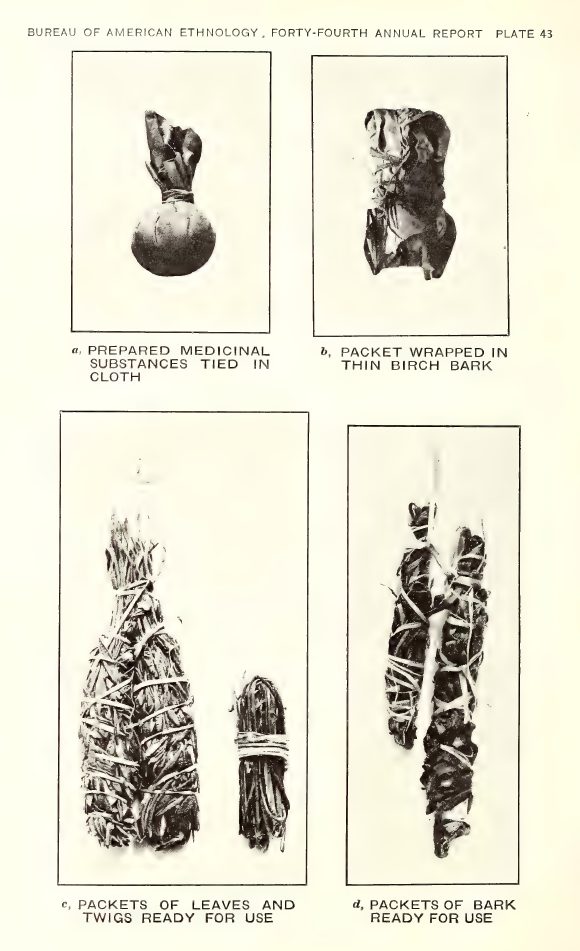
PLATE 43 a, Prepared medicinal substances tied in cloth; b, Packet wrapped in thin birch bark; c, Packets of leaves and twigs, ready for use; d, Packets of bark, ready for use page 67
PLATE 44 a, Mrs. Brunett; b, Mrs. Gagewin; c, Mrs. Louisa Martin page 78
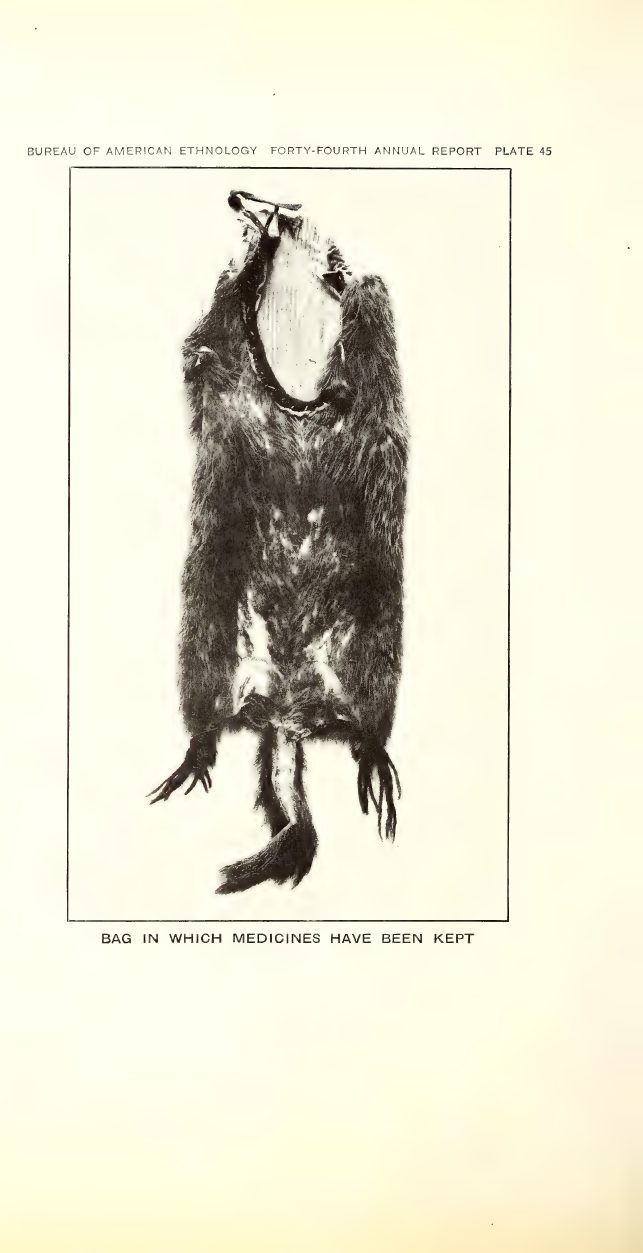
PLATE 45 Bag in which medicines have been kept page 79
PLATE 46 Surgical appliances page 88
PLATE 47 a, Taking basswood bark from water; b, Coils of basswood fiber page 138
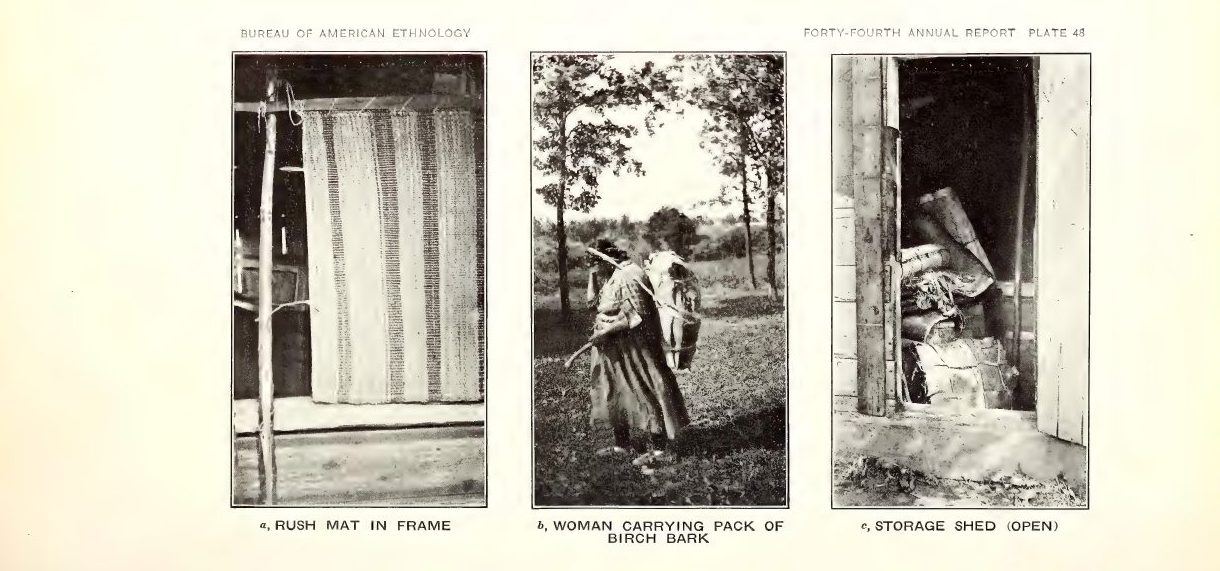
PLATE 48 a, Rush mat in frame; b, Woman carrying pack of birch bark; c, Storage shed (open) page 139
PLATE 49 Sweet grass and materials smoked in pipe, in natural and prepared forms page 140
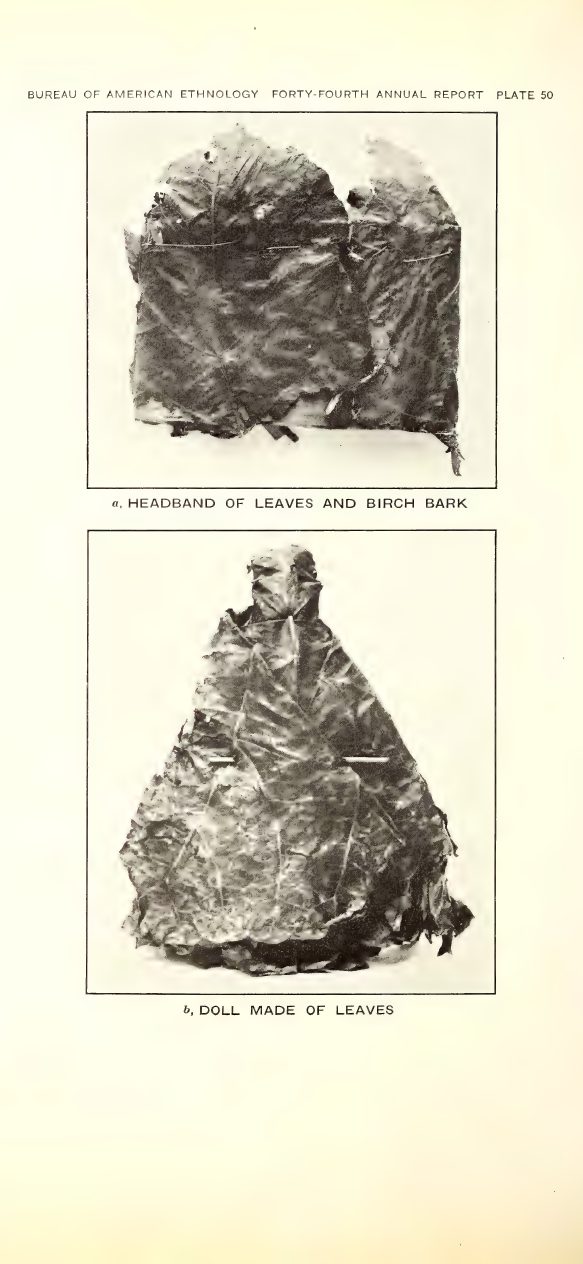
PLATE 50 a, Headband of leaves and birch bark; b, Doll made of leaves page 141
PLATE 51 a, Toys made of cat-tails; b, Dolls made of pine needles page 142
PLATE 52 a, “Coaster” made of slippery elm bark; b, Birch bark showing “picture of thunderbird”; c, Figures cut from birch bark page 143
PLATE 53 a, Cutting birch bark preparatory to removing; b, Removing birch bark from tree; c, Making container from birch bark page 154
PLATE 54 Meat bag, open and closed page 155
PLATE 55 Fans made of birch bark and feathers page 156
PLATE 56 Figures cut from birch bark page 157
PLATE 57 Patterns cut from birch bark page 158
PLATE 58 Leaves in which patterns have been bitten page 159
PLATE 59 Birch-bark transparencies page 164
PLATE 60 Birch-bark transparencies page 165
PLATE 61 Birch-bark transparencies page 166
PLATE 62 Birch-bark transparencies page 167
PLATE 63 Birch-bark transparencies page 168
04

IDEAS TO LEARN

20 things the report teaches that a plant list cannot. One line each, with the page.

  1. 01

    Tobacco first.

    Before a plant was dug, tobacco went into a hole beside it and the digger spoke to it. Gagewin’s words are recorded.

    You were allowed to grow here for the benefit of mankind, and I give you this tobacco to remind you of this. Densmore 1928, page 80
  2. 02

    A remedy is personal.

    Knowledge was individual property. Nobody claimed to know another person’s medicine.

    I can tell you about my own medicines. I do not know about other peoples’ medicines nor their uses of the same plants. Densmore 1928, page 76
  3. 03

    Every plant has a use.

    The Midewiwin teaching that organizes the whole report.

    It is a teaching of the Midewiwin that every tree, bush, and plant has a use. Densmore 1928, page 75
  4. 04

    Follow the bear path.

    Advancement in the medicine society was described as following the bear, and the bear was credited with the best remedies.

    Some of the best Mide remedies were received from the bear. Densmore 1928, page 76
  5. 05

    Roots before the sap.

    Timing was part of the recipe. Bark when the sap was up, roots before it rose or after it fell.

    Roots intended for future medicinal use were gathered before the sap started in the spring or after it had gone down in the fall. Densmore 1928, page 81
  6. 06

    The elbow of the root.

    Potency was located, not averaged. Dogbane’s strength was at the bend where the root turns sideways.

    The strongest medicinal value is at the elbow where the root turns. Densmore 1928, page 94
  7. 07

    Nine hundred taps.

    A sugar bush was measured in taps, not trees. Large camps ran to two thousand.

    Nine hundred taps was an average size. The number of taps was reckoned by hundreds. Densmore 1928, page 52
  8. 08

    Sugar before salt.

    Maple sugar seasoned fish, meat, cereals and vegetables. Salt came by treaty in 1847 and stayed a foreign taste.

    In the early days the Minnesota Chippewa had no salt and some of the older Indians have not yet acquired a taste for it. Densmore 1928, page 71
  9. 09

    Women claimed the rice.

    Ten days before ripening, a woman tied her portion of the field into sheaves. That was the title deed.

    A woman established her claim to it by going to the field about 10 days before the rice was ripe and tying portions of it in small sheaves. Densmore 1928, page 56
  10. 10

    A canoeful a day.

    The unit of harvest was the boat. Good gatherers took ripe kernels and left the green ones for the next pass.

    A canoeful of rice was considered a day’s gathering. Densmore 1928, page 57
  11. 11

    They boiled their water.

    Travelers did not drink from the lake. They boiled it and steeped something in it: Labrador tea, wintergreen, cherry twigs.

    The Chippewa did not commonly drink water encountered in traveling but boiled it. Densmore 1928, page 70
  12. 12

    Twenty flowers by July.

    One woman dried a few of each flower as it appeared, from the first of spring, and had a winter drink by fall.

    By the first of July she had more than twenty varieties. In the fall she pulverized them and stored them. Densmore 1928, page 70
  13. 13

    A large swallow.

    Dose was by mouth, not by measure. One careful practitioner’s pail held about a pint. Combinations ran to twenty herbs.

    Liquid medicine was not measured when taken. A ‘large swallow’ constituted an average dose. Densmore 1928, page 84
  14. 14

    Seven ways in, seven ways on.

    Densmore counts seven external and seven internal routes, from poultice and steam to smoke and enema.

    Remedies were administered externally in the following manner: (1) Fresh roots or leaves were macerated and applied. Densmore 1928, page 85
  15. 15

    Take some Juneberries with you.

    A saying, a song line, and the simplest form of refreshment on a journey.

    ‘Take some Juneberries with you,’ is a common saying among the Chippewa. Densmore 1928, page 74
  16. 16

    Color from plants, set with minerals.

    Two-part dyeing. Quills took color best. Rushes took it worst.

    The use of a vegetable substance to secure a color and of a mineral substance to ‘set’ it. Densmore 1928, page 126
  17. 17

    Talk and pray.

    A charm worked only if it was spoken over when gathered and when used. Some plants were both charm and medicine.

    It was considered necessary to ‘talk and pray’ over them when they were used, and, in the case of an herb, to ‘talk and pray’ when it was gathered. Densmore 1928, page 132
  18. 18

    Twine was infrastructure.

    Basswood inner bark, soaked and stripped, held the mats, the rice, the roofs and the packs together.

    Twine was one of the most important articles in the economic life of the Chippewa. Densmore 1928, page 135
  19. 19

    Bark unrolls only by fire.

    Birch bark was stored rolled and shaped by heat. A makuk cared for with balsam gum lasted ten years.

    Birch bark can be unrolled only by exposing it to the heat of a fire. When heated it becomes pliable. Densmore 1928, page 151
  20. 20

    Art with teeth.

    Fold a leaf or thin bark, bite a line, unfold, hold it to the light. Winter evenings, sugar camp, and the source of beadwork patterns.

    The only material is a broad leaf or thin piece of birch bark and the only tools are human teeth and deft fingers. Densmore 1928, page 153
05

THE SHELF

Everything Densmore published on the Chippewa, 1910 to 1929. Five books, 62 highlights, 25 photographs. The scans are public, on the Internet Archive and from the Smithsonian. Each line opens the exact page.

01 · 1910 · Bureau of American Ethnology, Bulletin 45

Chippewa Music

Frances Densmore's first Bureau of American Ethnology bulletin gathers 200 Chippewa songs recorded by phonograph during 1907, 1908, and 1909 on the White Earth, Leech Lake, and Red Lake reservations in Minnesota. The record covers the Mide' or Grand Medicine society, its origin narrative, initiation ceremonies, and healing songs, then turns to dream songs, war songs, love songs, moccasin-game songs, and the Fourth of July dances at Red Lake. Densmore names her singers, among them Main'ans, O'deni'gun, Na'waji'bigo'kwe, De'bwawen'dunk, Ga'gandac', and Mrs. Mary Warren English, and prints their own accounts of where the songs came from.

Main'ans
Wa'wiekum'ig
Main'ans as leader of a Mide' ceremony
De'bwawen'dunk
Ge'miwunac'
Chippewa doctor treating the sick
Manido'gicigo'kwe
The Fourth of July at Red Lake agency

THE HIGHLIGHTS · 18

  1. Songs alive, not specimens

    Densmore opens by insisting that Chippewa music is a living practice. A returning traveler is asked first what new songs he learned on the other reservation.

    Chippewa songs are not petrified specimens; they are alive with the warm red blood of human nature. Music is one of the greatest pleasures of the Chippewa.
    Densmore 1910, page 24 · open the scan
  2. How each cylinder was recorded

    Densmore describes her phonograph method. The spoken singer name, song number, and a pitch-pipe C at the head of each cylinder identified the record and fixed the machine's speed.

    Before recording a song the name of the singer, the number of the song, and the tone C of a pitch pipe are given into the recording horn.
    Densmore 1910, page 26 · open the scan
  3. Translating the Mide' words

    Many words in the Mide' songs were no longer conversational Chippewa. Densmore wrote that the final translations were settled by three interpreters sitting with two members of the society.

    Nine or ten interpreters have been employed on many of them, the final translation being made by three particularly efficient interpreters in consultation with two members of the Mide'wiwin.
    Densmore 1910, page 42 · open the scan
  4. Na'waji'bigo'kwe tells the origin

    The Mide' origin narrative is given by Na'waji'bigo'kwe, 'woman dwelling among the rocks', and interpreted by Mrs. Mary Warren English, sister of the historian William Warren. It places the first teaching on Madeline island.

    Originally all the inhabitants of the earth (Chippewa Indians) who were to learn the Mide' lived on Madeline island, in Lake Superior, and in that portion of the country. They were selected by the Mide' manido' to be taught the Mide' religion.
    Densmore 1910, page 48 · open the scan
  5. O'deni'gun's Song of the Four Bears

    O'deni'gun sang the first song in the book and told its story. A young man named Awi'hinedja' leapt from a cliff at his uncle's command, and four bears sang him back to life.

    Four bears came and walked around his body, singing this song. When the young man regained consciousness he heard the bears singing; when he opened his eyes he saw the bears walking around him, and when they had walked around him four times he rose up strong and well.
    Densmore 1910, page 58 · open the scan
  6. A lodge judged by the drum

    Densmore wrote that a first-degree Mide' lodge ran 50 to 100 feet, and that older lodges were remembered as far longer. The drum carried where voices could not.

    the lodge at that time is said to have been so long that a person at one end could not hear voices at the other end and could judge the progress of the ceremony only by the sound of the drum.
    Densmore 1910, page 67 · open the scan
  7. Twenty shots for Flat Mouth

    In July 1907 at Leech Lake, Densmore attended the Mide' ceremony held over the dying chief Nigan'ibines', or Flat Mouth, led by the nearly blind Ge'miwunac'. The record notes how his death was announced.

    Two hours later Flat Mouth died, his death being announced by twenty rifle shots. This is the custom of the tribe, a few shots announcing the death of a child and a larger number that of an adult.
    Densmore 1910, page 89 · open the scan
  8. De'bwawen'dunk addresses the manido'

    De'bwawen'dunk of Bois Fort, a sixth-degree member, recorded his initiation songs in Washington. Before singing he smoked in silence and made a speech to the spirits who owned the songs.

    I am not doing this for the sake of curiosity, but I have smoked a pipe to the Mide' manido' from whom these songs came, and I ask them not to be offended with me for singing these songs which belong to them.
    Densmore 1910, page 96 · open the scan
  9. A love-charm song recognized

    An elderly Red Lake woman sang a love-charm song reluctantly and drew its picture. Months later Na'waji'bigo'kwe at White Earth knew the drawing at sight and sang the same song into the phonograph.

    With coy shyness she said the song meant that she was as beautiful as the roses. She also drew a crude picture of the song. Later this picture was shown to Na'waji'bigo'kwe at White Earth. She recognized the picture at once and sang the song into the phonograph.
    Densmore 1910, page 127 · open the scan
  10. Niogi'cig composes while sick

    Niogi'cig of Gull Lake lay ill for a long time before sending tobacco to the Mide' men. The record says he composed this healing song himself on a drum they made for him.

    They made him a drum and he played on it and sang this song, which he composed himself. The words mean, ‘It was told me in my dream that I should do this and I would recover.’
    Densmore 1910, page 136 · open the scan
  11. Main'ans and his frozen feet

    The younger Main'ans, who walks on his knees, told Densmore how his doctor's songs came to him. As a boy he survived a snowstorm that killed his grandparents, and the songs came during years of pain.

    His grandparents finally perished of cold and starvation, but he found his way to the village with both feet frozen. Years of suffering followed. When the pain was most severe these songs, Main'ans said, one after another, ‘rang in his head.’
    Densmore 1910, page 160 · open the scan
  12. Main'ans visits the bear's lodge

    Before recording the doctor's song 'I Go to the Big Bear's Lodge', Main'ans explained where it came from. Every dja'sakid, he said, has an animal seen in a dream who teaches him.

    In my dream I went to the big bear's lodge and he told me what to do. He told me how to swallow the bones and I often go back to his lodge that I may learn from him again.
    Densmore 1910, page 165 · open the scan
  13. The juggler Ce'deens' bound and freed

    Ga'gandac', 'one whose sails are driven by the wind', sang the song of the juggler Ce'deens' and described the performance he had witnessed. The bound man was thrown into a lodge of eight poles.

    One of the four men then called, ‘Come, ye people of the sky, come and smoke.’ In a few moments the poles began to shake; the whole structure rocked and swayed as though a tornado were blowing; yet there was no wind and the sky was cloudless.
    Densmore 1910, page 166 · open the scan
  14. Song of the Deserted Warrior

    Henry Selkirk sang a song said to have sprung from a wounded man named No'dinuk'wum, Wind-Thunder, left behind after a fight with the Sioux near Turtle mountain. His companions heard it, turned back, and carried him to a canoe.

    they left him with his face painted and a feather in his hair, to die like a warrior. After they had left him they heard him singing this song. It was an entirely new tune and two of the men remembered it and sang it after they reached home.
    Densmore 1910, page 178 · open the scan
  15. Manido'gicigo'kwe alone in the timber

    The singer of two love songs, Manido'gicigo'kwe, 'spirit day woman', lived alone in a log cabin between two lakes. Densmore's footnote gives one of the book's sharpest portraits, and her photograph is plate 11.

    In this desolate place Manido'gicigo'kwe and her dogs guard the timber of her government allotment, the while she gathers roots from which she makes love powders to sell to the children of men. In her hand she usually carries a small hatchet.
    Densmore 1910, page 191 · open the scan
  16. Mrs. English remembers Duluth

    Mrs. Mary English, sister of William Warren, sang 'My Love has Departed', a song from Madeline island. Densmore's footnote records her memory of her brother's prophecy on the empty shore of Lake Superior.

    Mr. Warren stood beside his canoe on the shore, stretched out his hand over the water, and said, ‘Some day this lake will be a highway of water where hundreds of boats will come and go;’
    Densmore 1910, page 195 · open the scan
  17. Dawn drum at Red Lake

    Densmore reached Red Lake on July 2, 1908, to study the music of the Fourth of July celebration, run entirely by the Indians themselves. Her account of the holiday morning begins before sunrise.

    It was 3 o'clock; the red dawn lay close to the pine trees in the east, and from the Indian camp arose the deep throb of a drum. Never was national holiday ushered in more impressively.
    Densmore 1910, page 212 · open the scan
  18. The storm that stopped a hanging

    Gi'wita'bines, 'spotted bird', sang a song credited to Djige'weckun, who was taken to St. Paul for trial when the town had one house. The record says he composed it as a prisoner and later became a chief.

    The man was condemned to be hanged, but just as they were going to hang him a terrible storm arose. The clouds were right over the tree where he was going to be hung. Lightning struck the tree and the rain poured down so that everybody went home.
    Densmore 1910, page 246 · open the scan
CONTENTS · 25 SECTIONS · EACH OPENS THE SCAN
  1. Introductionpage 24
  2. Tabulated analysis of 180 songspage 31
  3. Musical instrumentspage 38
  4. The Mide'page 40
  5. Use of medicinepage 47
  6. Originpage 48
  7. Initiation ceremony of the first degreepage 51
  8. Ceremony for a dying chiefpage 86
  9. Songs for initiation into the sixth degreepage 94
  10. Ceremonial songspage 101
  11. Songs to insure successpage 121
  12. Love-charm songspage 127
  13. Songs connected with the cure of the sickpage 131
  14. Songs connected with rare medicinespage 137
  15. Additional Mide' songspage 147
  16. Dream songs (White Earth and Leech Lake)page 159
  17. War songs (White Earth and Leech Lake)page 180
  18. Love songs (White Earth and Leech Lake)page 191
  19. Moccasin-game songs (White Earth and Leech Lake)page 201
  20. Unclassified songs (White Earth and Leech Lake)page 206
  21. Social songs on Red Lake reservationpage 211
  22. The singers of Red Lakepage 220
  23. War songs (Red Lake)page 223
  24. Woman's-dance songs (Red Lake)page 239
  25. Indexpage 258

02 · 1913 · Bureau of American Ethnology, Bulletin 53

Chippewa Music II

Frances Densmore's second Chippewa volume presents 340 songs recorded on the phonograph at White Earth, Leech Lake, Red Lake and Lac du Flambeau between 1909 and 1911, transcribed and tabulated in ordinary notation. War is the keynote: the blind warrior Odjib'we's personal songs, a full account of a war expedition, songs of the peace pact, and the Drum-presentation Ceremony in which Lac du Flambeau Chippewa carried two drums to the Menominee in October 1910. The record also covers dream, Mide', love, moccasin game, begging dance and children's songs, medicine poles, notes on singers, and a Sioux comparison.

Plate 1. Odjib'we
Plate 9. Main'gans
Plate 13. Meja'kigi'jig
Plate 20. Mec'kawiga'bau
Plate 22. Chippewa shaking hands with Menominee. Menominee listening to singing of Chippewa. Participants in Drum-presentation Ceremony
Plate 26. E'niwub'e
Plate 30. Mrs. Benjamin Gauthier
Plate 43. Chippewa camp at Waba'cing, Minn.

THE HIGHLIGHTS · 18

  1. An Indian throat for the vocables

    In the opening analysis Densmore describes how Chippewa singers produce the throaty syllables that carry many songs, quoting a saying she heard from the singers.

    It is said that ‘one must have an Indian throat to sing the songs properly.’ A Chippewa does not move the lips in giving these vocables, but seems to produce them by a contraction of the glottis
    Densmore 1913, page 42 · open the scan
  2. All important songs composed in dreams

    The record states that the songs of greatest value came to a man in a fasting dream and were sung in time of danger to draw on the power of that dream.

    It is said that in the old days all the important songs were ‘composed in dreams,’ and it is readily understood that the man who sought a dream desired power superior to that he possessed.
    Densmore 1913, page 45 · open the scan
  3. Sioux likeness is rhythmic, not melodic

    Comparing the Waba'cing songs with Sioux songs of the Drum-presentation Ceremony and Teton Sun-dance songs from Standing Rock, Densmore locates the shared trait in a division of the count.

    It is interesting to note that the correspondence between the music of the Chippewa and the Sioux, which may be attributed to contact of the two tribes, is rhythmic, not melodic.
    Densmore 1913, page 40 · open the scan
  4. Thirty love songs, one happy

    The group analysis of love songs, illustrated by a lover's flute from Lac du Flambeau, notes that only Mrs. Spears's song No. 177 expresses happiness.

    The love songs of the Chippewa are plaintive in character, usually expressing sadness and disappointment. Thirty of these songs have been recorded and only one of this number is inspired by happiness
    Densmore 1913, page 71 · open the scan
  5. Odjib'we dies in April 1911

    Odjib'we, the blind war leader of the Mississippi Band who sang more than 70 songs for the phonograph at White Earth from 1909, died before the volume was printed.

    Odjib'we died in April, 1911. Many of the songs herein preserved were known only to him. He stood alone, his preeminence unquestioned by his tribe throughout northern Minnesota.
    Densmore 1913, page 93 · open the scan
  6. Odjib'we gives away his dream song

    After recording the dream song he had sung before battles, in which a woman appeared with guns made of rushes, the old warrior feared the consequence of parting with it.

    After the recording of this song on the phonograph the aged warrior bowed his head and said tremulously that he feared he would not live long, as he had given away his most sacred possession.
    Densmore 1913, page 114 · open the scan
  7. War party leaves without farewells

    In the account of a war expedition, four women with clay-whitened faces sang and moved before the warriors as they left the village for Sioux country.

    These women had their faces whitened with clay. At last they divided, two standing on each side of the path, and the warriors passed between them. There were no farewells and the song did not cease.
    Densmore 1913, page 152 · open the scan
  8. Name'bines' composes his death song

    Mortally wounded after killing a Sioux, the warrior Name'bines' sang a new song to his comrades and gave instructions for its use at home.

    When Name'bines' was laid in the bushes he sang his death song, which he is said to have composed at that time. Looking into the faces of his comrades he said, ‘When you reach home sing this for the women to dance by and tell them how I died.’
    Densmore 1913, page 172 · open the scan
  9. Bica'ganab fights like a bear

    John W. Carl related the story of the brave woman Bica'ganab, who fought the Sioux in the water during a canoe battle and later had a song and a dance in her honor.

    The Sioux followed, trying to strike her on the head with a club, but she actually broke and tore their canoe with her hands. It was said that she was like a great bear in her ferocity.
    Densmore 1913, page 192 · open the scan
  10. Wis'kino on keeping the drum

    The Menominee chief Wis'kino, who received a chief drum from the Lac du Flambeau Chippewa in October 1910, described through interpreter Frank Gokay how the drum would live in his house.

    I will keep this drum in my house. There will always be tobacco beside it and the drum pipe will always be filled. When I smoke at home I will use the pipe that belongs to the drum. My friends will come to my house to visit the drum.
    Densmore 1913, page 204 · open the scan
  11. A veteran gives his strength

    At the Restoring the Mourners ceremony at Lac du Flambeau on October 16, 1910, White Feather's widowed mother was released from mourning by an old soldier's speech and red paint.

    An old man arose and, leaning on his staff, said that he had fought in the Civil War. He told of his bravery as a soldier and said that he would give to this mourning woman the strength and power which upheld him on the field of battle.
    Densmore 1913, page 223 · open the scan
  12. Forlorn return from the Menominee

    About 70 Chippewa took the train to Antigo and walked 20 miles to give two drums to the Menominee; snow fell during the closing dances and they walked back with lighter packs.

    It was a rather forlorn company that returned to Lac du Flambeau; yet it was something to have been for a little while on the heights and to have given two drums to the Menominee.
    Densmore 1913, page 253 · open the scan
  13. Water flows from the medicine pole

    E'niwub'e of Lac du Flambeau recalled the song his grandfather sang when he and other boys returned from their fasting vigil and danced around a medicine pole with a hole below the deerskin banner.

    water flowed from the hole in the pole and fell into the dish. When it was full E'niwub'e's grandfather stopped the dancers and gave them this water to drink. In this manner their fast was broken.
    Densmore 1913, page 282 · open the scan
  14. Dogs give the begging song

    E'niwub'e told the origin of the begging dance, said to come from the Assiniboin, in which a newborn Sioux boy lay outside the wigwam among the dogs until he could creep.

    It was said that the dogs gave this song to a boy during the time that he spent among them. E'niwub'e said that the dogs did not sing the song but willed the boy to know it and he did.
    Densmore 1913, page 327 · open the scan
  15. Me'dweya'sun's song never sung

    The Lac du Flambeau chief Me'dweya'sun dreamed in youth of leaping a fallen tree in war, but no war came, so he raised an uprooted tree as his medicine pole at the height of the tree in the dream.

    He felt obliged to do this because he ‘had not fulfilled his dream,’ but the song which should have inspired his warriors was buried in his heart.
    Densmore 1913, page 358 · open the scan
  16. Awun'akum'igickun' sat with the old men

    At the July 4, 1910 gathering at Waba'cing on Red Lake, a Canadian Chippewa from the Rainy River country about 30 years old, who spoke no English, sang 11 songs in a throaty falsetto.

    He said that when he was a little boy he ‘sat with the old men,’ listening to their singing and learning their songs, but that now he sang the songs which the men of his village ‘made up in their dreams.’
    Densmore 1913, page 365 · open the scan
  17. Mrs. Spears remembers two love songs

    Mrs. Julia Warren Spears, sister of historian William Warren, learned two songs at 15 from a chief's daughter on Madeline Island and sang them at White Earth at over 70 years of age.

    Mrs. Spears learned these songs more than 60 years before they were recorded by the phonograph. The writer heard them sung by Mrs. Spears at intervals during a period of several years and the renditions never varied in any respect.
    Densmore 1913, page 417 · open the scan
  18. John W. Carl's game of silence

    John W. Carl, a Haskell Institute graduate whose Chippewa mother sang this song, recorded the children's song that opened a contest in keeping still, with a pile of presents for the winner.

    The ‘game of silence,’ which consisted in keeping still as long as possible, was played by the children at the suggestion of the older members of the family. It is said to have been called frequently into requisition when the adults wished to discuss matters of importance.
    Densmore 1913, page 420 · open the scan
CONTENTS · 25 SECTIONS · EACH OPENS THE SCAN
  1. Forewordpage 12
  2. Analysis of Chippewa musicpage 30
  3. Tabulated analysis of 340 songspage 47
  4. Group analysis of 340 songspage 63
  5. War songs of the Mississippi Band of Chippewapage 92
  6. Songs connected with Odjib'we's personal experiencepage 114
  7. Personal reminiscences of three warriorspage 136
  8. Description of Chippewa war expedition, with typical songspage 144
  9. Songs on the return of a victorious war partypage 177
  10. Songs of the peace pactpage 187
  11. War songs concerning womenpage 191
  12. Children's games of warpage 198
  13. Drum-presentation Ceremonypage 203
  14. Ceremony of restoring the mournerspage 220
  15. Ceremony of divorcepage 229
  16. Presentation of the drumpage 239
  17. Dog Feastpage 246
  18. Tabulated analysis of Sioux songs of Drum-presentation Ceremonypage 254
  19. Songs of the Lac du Flambeau Reservationpage 257
  20. Songs concerning a boy's fastpage 281
  21. The symbols of songs which never were sungpage 352
  22. Songs of the Chippewa at Waba'cing village, Red Lake Reservation, Minnesotapage 364
  23. Songs of White Earth Reservationpage 408
  24. Rhythmic units of Chippewa songspage 426
  25. Authorities citedpage 450

03 · 1917 · Privately printed, Washington, D.C.

Poems from Sioux and Chippewa Songs

A small booklet Densmore printed herself in 1917. Twenty-one songs she had recorded on the phonograph, turned into English poems that keep the original rhythm of the melody. Each poem sits beside its literal translation and a note on how the song was used. The Sioux words were translated by Robert Higheagle, the Chippewa words by Mary Warren English and the Rev. C. H. Beaulieu, both Chippewa. The Chippewa songs are numbers 10 to 21: war customs, a thunderbird doctoring song, love songs, a crow song, a mother asking for a chief's daughter, a child afraid of the owl, and a lullaby with no words.

Title page, Poems from Sioux and Chippewa Songs, 1917

THE HIGHLIGHTS · 8

  1. Why the poems keep the rhythm

    Densmore explains the method. A literal translation gives the idea but loses the rhythm, so the poems are written to the melody.

    In a majority of Indian songs the rhythm is irregular and the native words follow this rhythm, a custom different from our own, in which the music follows the rhythm of the words.
    Densmore 1917, page 6 · open the scan
  2. Who translated the words

    The Chippewa translations came from two members of the tribe who worked with Densmore for years.

    Grateful acknowledgment is made to Mr. Robert Higheagle, a graduate of Hampton Normal and Agricultural Institute, who translated the Sioux words, and to Mrs. Mary Warren English and Rev. C. H. Beaulieu, members of the Chippewa tribe, who translated the words of the Chippewa songs.
    Densmore 1917, page 8 · open the scan
  3. The women walk ahead of the war party

    Song No. 11. A war custom recorded from the Minnesota Chippewa: the women sing the warriors out of the village and back.

    When a Chippewa war-party left the village, the women walked before the warriors, all singing this song. After going some distance, the women divided and stood in two lines, between which the warriors passed on their way.
    Densmore 1917, page 18 · open the scan
  4. Thunderbirds in a doctoring song

    Song No. 13 was used in treating the sick. Densmore reads it as a dream song of the thunderbirds.

    The lightning flash is the gleaming of their terrible eyes; The roll in the storm-swept sky Is the noise of the thunderbird's wings.
    Densmore 1917, page 20 · open the scan
  5. A love song carried from La Pointe

    Song No. 15 was recorded in western Minnesota but was said to have come with the Chippewa from La Pointe, Wisconsin, a generation earlier. Songs travelled with people.

    This song was recorded in western Minnesota, but was said to have been brought by the Chippewa from La Pointe, Wisconsin, a generation ago.
    Densmore 1917, page 22 · open the scan
  6. The crow who brings the rain

    Song No. 18, heard by a young man in a fasting vision, after which he was said to understand the crows.

    The first to come I am called among the birds. I bring the rain. Crow is my name.
    Densmore 1917, page 24 · open the scan
  7. A brass kettle for a bride

    Song No. 19, an ambitious mother asks chief Bugac for his daughter. The brass kettle was one of the most valued things a Chippewa woman owned.

    A brass kettle was among the most valued possessions of a Chippewa woman in the early days, yet the words imply that her son, and not herself, will bestow this kettle upon the prospective bride.
    Densmore 1917, page 24 · open the scan
  8. A lullaby with no words

    Song No. 21. Chippewa women sang their lullabies on syllables, not words. Densmore supplied the poem.

    Little baby, sleep, Mother swings your hammock low; Little birds are asleep in their nest. Way, way, way, way, way.
    Densmore 1917, page 26 · open the scan
CONTENTS · 3 SECTIONS · EACH OPENS THE SCAN
  1. Introductionpage 6
  2. Sioux songs, Nos. 1 to 9page 10
  3. Chippewa songs, Nos. 10 to 21page 16

04 · 1928 · Bureau of American Ethnology, 44th Annual Report · 193-page scan

Uses of Plants by the Chippewa Indians

The book this room is built from. Nearly 200 plants named in Chippewa, Latin and English, with what each was used for, then the chapters above: sugar, rice, food, medicine, dyes, charms, arts, Winabojo, birch bark. Hosted here as the full Smithsonian scan with page-level links. Dover reissued it in 1974 as How Indians Use Wild Plants for Food, Medicine and Crafts; those copies are borrow-only on the Internet Archive and carry the same text and plates.

05 · 1929 · Bureau of American Ethnology, Bulletin 86

Chippewa Customs

Frances Densmore gathered this record of Chippewa life between 1905 and 1925 on reservations in Minnesota, Wisconsin, and Canada, working through interpreter Mary Warren English. Named informants such as Nodinens, Gagewin, Maingans, Odinigun, Niskigwun, Mrs. Razer, and Nawajibigokwe describe dwellings, clothing, food, childbirth, naming, dreams, the Midewiwin, charms, games, the yearly round of sugar, rice, and hunting camps, annuity payments, trade, canoes, mats, tanning, flutes, picture writing, and beadwork. Measurements, prices, dates, and procedures are given throughout, with 90 plates and 27 figures.

Plate 2. a, Portrait of Mrs. Mary Warren English; b, Portrait of Niskigwun
Plate 5. a, Old log dance house, Mille Lac, Minn.; b, Peaked lodge covered with birch bark, Grand Portage, Minn.
Plate 21. Portrait of Odinigun
Plate 42. Portrait of Nodinens
Plate 43. Making maple sugar at Mille Lac, Minn.
Plate 48. Portrait of Endusogijig
Plate 57. Process of making a canoe
Plate 69. a, Winding yarn for netting belt; b, Nodinens, netting belt

THE HIGHLIGHTS · 18

  1. Interpreter born on Madeline Island

    Densmore's interpreter for fourteen years was Mary Warren English, daughter of a fur trader and great-granddaughter of a Chippewa chief. The record gives her birth year and her father's post.

    Mrs. Mary Warren English (pl. 2, a), the writer's interpreter during a work which extended from 1907 to 1921, was born on Madeline Island in 1835. Her father was Lyman M. Warren, who was then in charge of the trading post of the American Fur Co.
    Densmore 1929, page 21 · open the scan
  2. La Pointe subagency counted 5,532 Chippewa

    Densmore drew on Office of Indian Affairs reports for population figures. The 1839 count covered bands from Grand Portage to Mille Lac.

    The subagency at La Pointe, in 1839, controlled Chippewa to the number of 5,532, living at Grand Portage, Vermilion, Leech Lake, Red Lake, Gull Lake, Mille Lac, and other localities in Minnesota.
    Densmore 1929, page 24 · open the scan
  3. Basswood strips soaked for wigwam ties

    Densmore watched a woman build a wigwam frame at White Earth and recorded each step. The lashing material was prepared in a pail of water.

    The woman in charge of the work had a large pail of water in which she soaked wide strips of basswood about 1 yard in length. When these had softened she took them from the water and separated them into layers
    Densmore 1929, page 44 · open the scan
  4. Woman's dress cost $5 in furs

    Traders carried four grades of broadcloth in the 1860s. The record prices the cheapest and says the other three cost about twice as much.

    The cheapest quality was dark blue coarse broadcloth with a white border. Enough of this for a woman's dress cost the equivalent of $5 in furs. The three other kinds cost about double that amount
    Densmore 1929, page 55 · open the scan
  5. Guns fired to announce a birth

    A birth set off a mock struggle for the baby between the father's gens and another gens. The record describes the water throwing and wrestling that followed.

    If a baby was born during the night it was customary to notify the people by firing guns. Immediately the men of the father's gens and those of one other gens went to the wigwam and attempted to gain possession of the child
    Densmore 1929, page 83 · open the scan
  6. Nodinens's earliest memory of her mother

    Nodinens of Mille Lac recalled how girls were taught. Her mother pulled her ear while repeating the instruction to be industrious.

    The first thing I can remember was my mother's saying 'always be industrious. Get up early and do your work. Do you hear me? Do you hear me? Do you understand?' She took hold of my ear and pulled it hard as she said this
    Densmore 1929, page 100 · open the scan
  7. Odinigun fasted eight days, then ten

    Odinigun described the fasting behind his dream of power to heal. The first attempt produced no vision, the second lasted ten days.

    Odinigun said that he prepared himself by fasting. In his first attempt to secure a dream he scarcely tasted food or water for eight days, but he saw no vision. The next time he fasted for 10 days.
    Densmore 1929, page 114 · open the scan
  8. Niskigwun sprinkled whisky on the water

    Wind-bound on a lake, Niskigwun sprinkled whisky and tobacco on the water and recalled his youthful dream of calm water. The record gives the time until the wind changed.

    he also strewed tobacco on the water and said that he desired the water to become like that which he saw in his youthful dream. In half an hour the wind veered and they were able to proceed on their way.
    Densmore 1929, page 126 · open the scan
  9. Gagewin on the Midewiwin's purpose

    Three members of the Grand Medicine Society were the main informants over 14 years on five reservations. Gagewin stated the society's purpose in one sentence.

    The study extended over a period of 14 years and data were obtained on five reservations. Gagewin said, "The Midewiwin is not so much to worship anything as to preserve the knowledge of herbs for use in prolonging life
    Densmore 1929, page 133 · open the scan
  10. Mide roll passed through three generations

    The birch-bark roll in Plate 34 came from Gagewin in 1918. The record traces its ownership from Black Hawk to his son and grandson.

    The roll herein illustrated (pl. 34) was first owned, as far as known, by Black Hawk, who left it to his son Mountain, who in turn transferred it to his son Gagewin, from whom the writer obtained it in 1918.
    Densmore 1929, page 137 · open the scan
  11. A Mide lodge 200 feet long

    Densmore measured a Grand Medicine lodge at Lac Court Oreilles in 1921, where about 200 Chippewa had just held a ceremony.

    This lodge was about 200 feet long, 13 feet wide, and 7 feet high, with openings approximately north and south at the ends of the structure.
    Densmore 1929, page 139 · open the scan
  12. Mrs. Razer's thunderstorm charm stone

    Mrs. Razer kept a spherical stone for 14 years to turn back thunderstorms. The record gives her explanation and the procedure with tobacco and a birch leaf.

    Mrs. Razer said that ‘the thunder bird likes this stone as a hen likes the egg she has laid and will not hurt it.’ She said that if a thunderstorm threatened, the proper procedure was to put this stone, with a little tobacco, on a birch leaf
    Densmore 1929, page 168 · open the scan
  13. Nodinens's father's notched calendar stick

    Nodinens, 74 years old, narrated a full year of Mille Lac life. Her account opens with her father's notched calendar stick begun each fall.

    He had a stick long enough to last a year and he always began a new stick in the fall. He cut a big notch for the first day of a new moon and a small notch for each of the other days.
    Densmore 1929, page 176 · open the scan
  14. Annuity coin arrived in $1,000 boxes

    Annuity coin arrived from Washington in sealed boxes. The record explains the Chippewa term that grew out of this.

    The coin was shipped from Washington in boxes, each of which contained $1,000. From this custom arose the use of a Chippewa word meaning ‘a little box full,’ in referring to one thousand dollars.
    Densmore 1929, page 203 · open the scan
  15. Tom Skinaway made ten arrows daily

    The record gives arrow range, deer shooting distance, and the daily output of a Mille Lac arrow maker.

    A good arrow would travel about 500 feet and the ‘shooting distance’ for deer was about 50 feet. Tom Skinaway said that when he was a young man he could make 10 arrows in a day, complete with points and feathers.
    Densmore 1929, page 216 · open the scan
  16. Flute length measured by hand spreads

    Chippewa flutes had six finger holes and were sized to the player. Tom Skinaway of Mille Lac, who made many flutes, gave the rule.

    Tom Skinaway said the flute should be two ‘spreads’ of the man's hand from the thumb to the end of the second finger, plus one ‘spread’ from the thumb to the end of the first finger.
    Densmore 1929, page 258 · open the scan
  17. Reading a birch-bark message by Nawajibigokwe

    Travelers left picture messages in a cleft stick. Nawajibigokwe drew one and Densmore recorded how it would be read.

    The message shown in Figure 18 was drawn by Nawajibigokwe and would be read as follows: Three canoes started at once. The occupants of two canoes camped here for two days and had plenty of food.
    Densmore 1929, page 270 · open the scan
  18. A grandmother's scissors hidden from use

    Scissors came with annuities and were treasured. Nawajibigokwe began cutting beadwork patterns from birch bark only after getting at her grandmother's pair.

    Nawajibigokwe, who gave much of the information in this section, said that her grandmother had a pair of scissors that she kept hidden under all her belongings lest some one should use and dull them.
    Densmore 1929, page 290 · open the scan
CONTENTS · 25 SECTIONS · EACH OPENS THE SCAN
  1. Forewordpage 18
  2. Informantspage 19
  3. Sketch of the life of Mary Warren Englishpage 21
  4. History of the Chippewa tribepage 23
  5. Totemic systempage 26
  6. Dwellingspage 39
  7. Clothingpage 53
  8. Foodpage 70
  9. Treatment of the sickpage 79
  10. Life cyclepage 83
  11. Dreamspage 123
  12. Midewiwin (Grand Medicine Society)page 133
  13. Stories and legendspage 150
  14. Charmspage 160
  15. Gamespage 169
  16. The industrial yearpage 176
  17. Chiefspage 192
  18. Customs pertaining to warpage 193
  19. Payment of annuitypage 203
  20. Traders and trading postspage 205
  21. Bows and arrowspage 215
  22. Canoespage 219
  23. Weaving of matspage 227
  24. Making of musical instrumentspage 252
  25. Picture writingpage 267

A NOTE FROM PROTO

Context.

A list of 155 plants is easy to misread as a menu. The chapters around the list are what stop that. They record who was allowed to know a remedy, what was said before a root was dug, and how the same people who kept the medicine also kept the sugar, the rice and the twine. The plants were never separate from the year.

We built this room so the field list has its context one tap away. Nothing here is interpretation we cannot point to a page for. When a summary of ours sits next to a quote of hers, the quote is the one to trust.

Proto · Red Wing / Mille Lacs / Minneapolis